


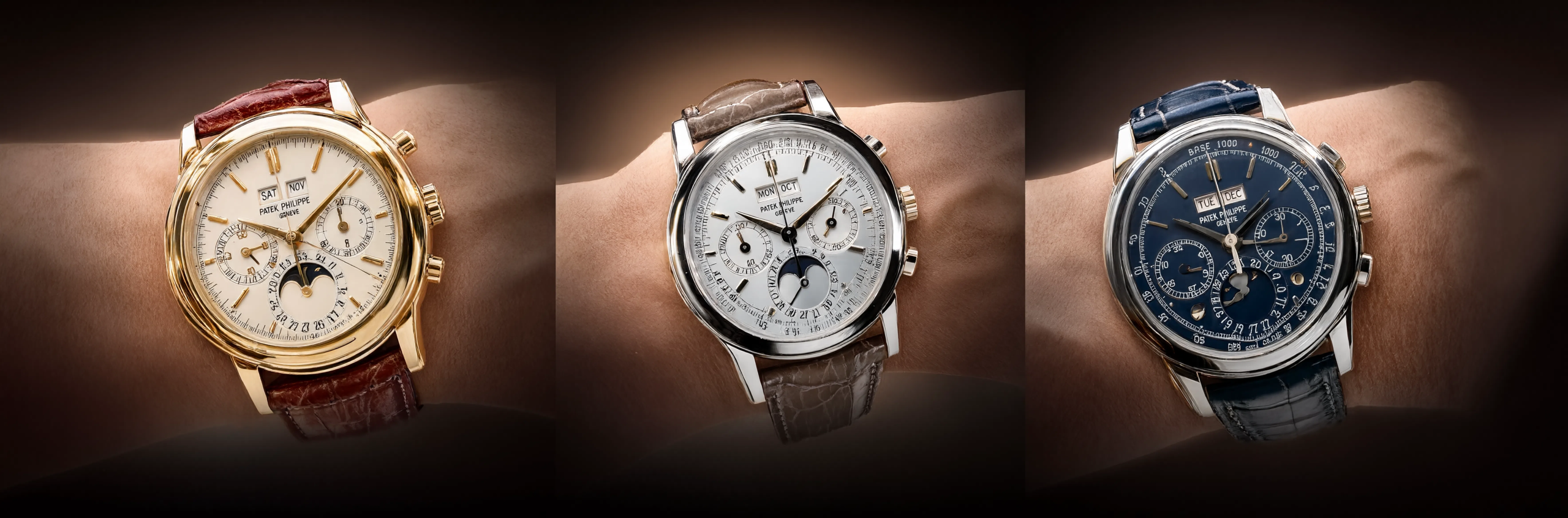
The Nautilus may get more attention. A minute repeater may be more exotic. And Patek Philippe has certainly made watches that are more complicated.
But if there is one watch that explains Patek Philippe, I believe it’s the perpetual calendar chronograph.
For more than 80 years, this combination has represented something fundamental about the manufacture: extraordinary mechanical complexity presented with remarkable restraint.
From the 1518 to the 2499, and later the 3970, 5970 and 5270, these aren’t simply successive references.
They are one of the great bloodlines in watchmaking.
Where It Began
In 1941, Patek Philippe introduced the 1518, the world’s first serially produced perpetual-calendar chronograph wristwatch.
Think about what that meant. A mechanical chronograph is already complicated. A perpetual calendar accounts for months of different lengths and leap years. Patek combined the two in a wristwatch more than eight decades ago.
Only 281 examples were produced.
The 2499 followed in 1951 and remained in production for roughly 35 years, becoming one of the most important watches in Patek Philippe history.
Put a 2499 next to a modern 5270 and you can still see the relationship.
That’s remarkable.
Patek didn’t continually reinvent this watch.
It evolved it.
The 3970: A Watch You Have to Discover
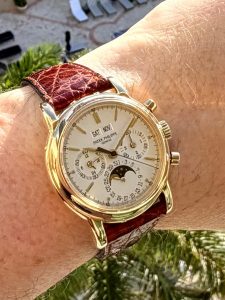
The 3970, introduced in 1986, brought the perpetual calendar chronograph into a new era.
At approximately 36mm, it can initially seem small by modern standards. But that’s part of its appeal.
There is an enormous amount happening on the dial, yet the watch never advertises its complexity. It remains elegant, restrained and almost anonymous.
You could wear a 3970 into a restaurant and almost nobody would notice it.
But the collector sitting two tables away might.
You don’t buy a 3970 because other people notice it. You buy it because you notice it.
Inside is Patek’s beautifully finished CH 27-70 Q, based on the Lemania 2310 architecture—an important connection to the generation that followed.
The 5970: Maybe They Got It Exactly Right
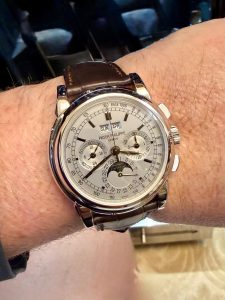
Then came the 5970 in 2004.
For me, this may be the sweet spot.
At approximately 40mm, it has considerably more wrist presence than the 3970. The dial has room to breathe, and the tachymeter scale gives it a slightly sportier personality.
But underneath, it retains the Lemania-based movement architecture of its predecessor.
That’s what makes the 5970 so interesting.
It has the proportions of a modern watch but much of the character and mechanical DNA of an older Patek.
Produced for only about seven years, it now feels like the closing chapter of an era.
The 5270: The Better Watch?
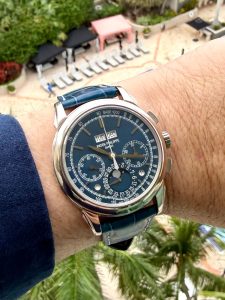
The 5270, introduced in 2011, marked an important change.
For the first time in this lineage, Patek’s perpetual-calendar chronograph was powered by a chronograph movement developed and manufactured entirely in-house, the CH 29-535 PS Q.
Technically, it’s extraordinary.
It’s larger, more contemporary and represents Patek taking complete control of the movement behind one of its signature complications.
By many objective measures, the 5270 is the better watch.
But as collectors eventually discover, better and more desirable aren’t always the same thing.
Which One Would I Keep?
Put a 3970, 5970 and 5270 next to each other and you’re looking at three different periods of Patek Philippe.
The 3970 is discreet and traditional.
The 5970 is the bridge between old and new.
The 5270 is technically accomplished and unmistakably modern.
If I wanted the purest expression of old-school Patek, I’d choose the 3970.
If I wanted the most technically advanced watch, I’d choose the 5270.
But if all three were sitting in front of me and I could keep only one?
I’d take the 5970.
It has enough of the 3970’s traditional character while wearing like a modern watch. It retains that wonderful Lemania-based architecture, yet at 40mm it has real presence on the wrist.
It exists at a point in Patek’s history that can’t really be recreated.
The Watch That Matters
Today, sports watches dominate much of the conversation around Patek Philippe.
But the Nautilus isn’t the watch that explains Patek Philippe to me.
The perpetual calendar chronograph is.
It connects today’s manufacture to watches Patek was making more than 80 years ago. Each generation has evolved technically without making the previous generation irrelevant.
And perhaps most importantly, it represents something Patek Philippe has always done exceptionally well:
Take something extraordinarily complicated and make it look effortless.
That’s why the Patek Philippe perpetual calendar chronograph isn’t simply one of the manufacture’s great complications.
It’s still the watch that matters.




3 Responses
“You don’t buy a 3970 because other people notice it. You buy it because you notice it.” This is a great line that as watch collectors reinforces the important principle of “buy what you love”.
I think the PCC remains the defining complication for Patek – and they set the standard even now. ALS, VC and others also offer the complication today – but they don’t really measure up to Patek’s offering, in my opinion.
It’s a shame the 5270 isn’t more loved, but maybe it will be one day. Like the 29-535 movement is technically impressive, the case is very well done… You might not love every iteration, but there’s enough variety in the 5270 line that there’s probably something you like. The harshest criticism I can really level is the pusher feel on the reset?
Marty, amazing article. Thanks for being a guide on this journey. Can’t wait for more! 🙂
Articles like this are what collectors need: a true voice coming from collectors themselves.