

There are watches you admire because they’re technically impressive, and there are watches you actually want to own.
For me, the original A. Lange & Söhne Datograph falls firmly into the second category.
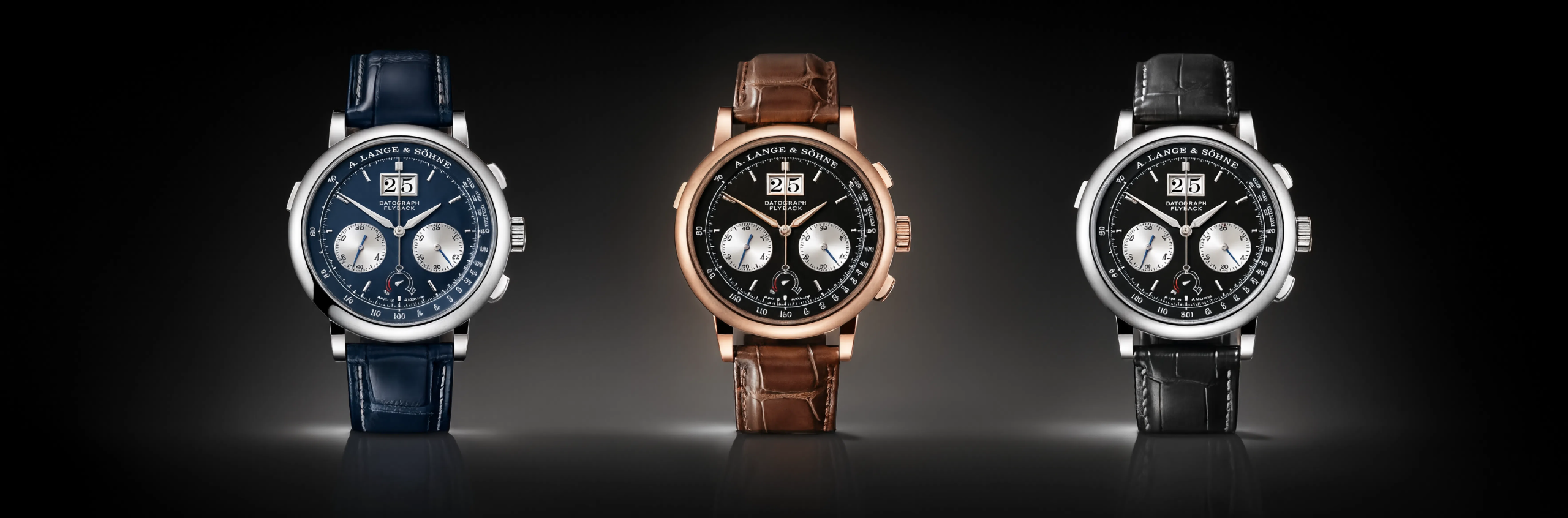
I’ll admit something from the beginning: the current Datograph Up/Down is probably the better watch.
It has a longer power reserve. The movement has been improved. The power-reserve indicator is genuinely useful. If you were designing a Datograph today with no regard for history, there are good reasons to choose the current version.
But if I were standing in front of both watches and could take only one home, I would choose the original 39mm Datograph.
And I don’t think I’d hesitate very long.
The Original Got the Proportions Right
Collectors talk endlessly about millimeters, sometimes to the point of absurdity. But with the Datograph, those millimeters matter.
The original platinum Datograph, reference 403.035, is 39mm. The current Up/Down is 41mm.
Neither is a large watch by today’s standards, but they don’t feel the same.
The original has a wonderful density to it. You pick up this relatively compact 39mm watch and feel the unexpected weight of platinum. On the wrist, it feels substantial without needing to look substantial.
That’s something I increasingly appreciate in watches.
The original doesn’t announce itself from across the room. You have to discover it.
I Prefer the Simpler Dial
The other difference is the power-reserve indicator.
The Up/Down display is useful and unmistakably Lange. I understand why they added it.
I just prefer the Datograph without it.
The oversized date at 12 and the two chronograph registers below create one of the most recognizable dial layouts in modern watchmaking. On the original, that’s essentially the entire composition.
It’s balanced.
Nothing needs to be added.
The newer watch gives you more information, but the original gives your eye more room.
For me, that’s the better trade.
Then There’s the Movement
Turn over an original Datograph and you remember why people became obsessed with this watch in the first place.
The calibre L951.1 isn’t simply a great chronograph movement. It’s one of those movements that helped define an era of modern watchmaking.
When Lange introduced the Datograph in 1999, the company had only returned to watchmaking a few years earlier. Then suddenly this relatively young, reborn German manufacture produced an in-house, manually wound, flyback chronograph of extraordinary complexity and finishing.
It was a statement.
More than 25 years later, looking through the caseback still feels special. There is depth everywhere—levers, wheels, bridges and springs layered over one another. Because there’s no automatic rotor covering everything, the entire mechanism is there to enjoy.
I’ve seen technically more complicated watches that are less interesting to look at.
Collectors Eventually Want the First One
This is where the argument goes beyond aesthetics.
As collectors, we eventually become interested in origins.
We want the first important version. The watch that introduced the idea. The reference that later watches trace themselves back to.
The current Datograph can be improved again. Lange could eventually give it an even longer power reserve, make another case modification or introduce another generation of the movement.
But Lange can never make another first Datograph.
The original 403.035 will always be the watch introduced in 1999.
It will always have the original 39mm proportions.
It will always contain the original L951.1.
And the earliest examples even have wonderful collector details such as the “METER” dial, rather than the later “METERS” tachymeter printing.
Those are precisely the small distinctions that tend to become more interesting as watches age.
Better Isn’t Always More Desirable
This is one of the things I find most fascinating about collecting watches.
We spend enormous amounts of time comparing specifications: power reserve, case size, movement architecture, water resistance, accuracy.
But eventually you realize that the watch with the best specifications isn’t necessarily the watch you want most.
The original Datograph’s roughly 36-hour power reserve isn’t particularly impressive today. The newer movement’s approximately 60 hours is clearly better.
I don’t care.
I’m not buying a Datograph because I need the world’s most practical chronograph.
I’m buying it because I want a piece of modern watchmaking history.
And that’s why, if I were choosing today, I’d look for a great original platinum 403.035—preferably an early example in excellent condition with its box and papers.
The new Datograph is the better watch.
I’d still buy the original.