



Heir to the watchmaking tradition of great historical masters such as John Harrison, Julien Le Roy, Abraham-Louis Breguet and Sir George Daniels
Bernhard Lederer is regarded as the master of escapements in contemporary watchmaking
He has won two GPHG awards for his two latest creations
Bernhard Lederer is a visionary master watchmaker whose work combines centuries of watchmaking tradition with revolutionary innovation. He is perhaps one of the greatest independent watchmaking craftsmen still relatively unknown to enthusiasts of independent horology.
Lederer has established himself as a master of mechanical watchmaking, an engineer in pursuit of perfection and an heir to the great watchmaking tradition shaped by geniuses such as John Harrison, Julien Le Roy, Abraham-Louis Breguet and George Daniels.
He is regarded as a master of escapements—the beating heart of every mechanical watch—thanks to his meticulous obsession with innovation and precision.
With a career spanning almost five decades, his relentless pursuit of absolute precision has earned him two awards at the Grand Prix d’Horlogerie de Genève.
Every timepiece he creates bears the imprint of his legacy: a combination of tradition, mechanical engineering and a profound respect for craftsmanship and excellence.
The beginnings of a master watchmaker
Born in 1958 in Kornwestheim, near Stuttgart, Bernhard Lederer became interested in watchmaking when he was barely a teenager, driven by curiosity about what brought to life the pocket watches he had inherited from his grandfather. Afraid of damaging them, he began going to the library to study the different types of movements.
With a clear determination to become a watchmaker, he left school just before graduating. His parents were deeply disappointed and tried to persuade him to choose a “serious” profession, but Lederer already knew exactly what he wanted to become.
In the late 1970s and early 1980s, mechanical watchmaking was struggling as quartz technology rapidly expanded around the world, and Switzerland was no exception. At a time when everyone was turning to quartz for its accuracy and affordability, there seemed to be little demand for mechanical watches, let alone clocks or highly complicated handcrafted timepieces.
Bernhard Lederer, however, chose to swim against the tide. He was inspired by the example of George Daniels, the English watchmaker, inventor and author of books on the history and craft of horology. In his day, Daniels was one of the most celebrated geniuses of independent watchmaking, capable of constructing complicated watches entirely by hand.
From the very beginning, Lederer set out to continue the tradition of historical watchmakers such as John Harrison, Julien Le Roy, Abraham-Louis Breguet and Sir George Daniels, among others, through the creation of innovative escapements and unique movements.
His watchmaking journey began in 1976, at the age of 18, with an apprenticeship at the Wuppertal Clock Museum, where he worked on the restoration of antique clocks.
He then worked independently, taking on commissions from auction houses, antique dealers and private clients for four years before being admitted to watchmaking master school.
He later attended the Pforzheim School of Watchmaking, where he obtained his master watchmaker qualification in 1984. His final project, presented in 1986, was a table clock featuring a 1,000-year, or secular, perpetual calendar that solved the problem of leap years and provided an 800-year accurate moon-phase indication, together with displays for solar eclipses and sidereal and synodic lunar phases. It also incorporated a gravity escapement, temperature compensation and a fusée-and-chain mechanism.
At the time, Lederer focused on the creation of table clocks because they allowed the beauty of the mechanism to be displayed in all its glory. While working on his masterpiece as his final school project, and when the clock was almost finished, a client became fascinated by it and asked whether he would be willing to make one for him—only somewhat more complicated. This became his first commission, a clock that would have an enormous influence on his career.
Years later, Lederer met George Daniels at the first exhibition organised by the AHCI in Basel, Switzerland. Daniels became interested in Lederer’s table clock and in the way his own Space Traveller had influenced the Masterpiece 1986 Table Clock.
Daniels encouraged him to continue his work as an independent master craftsman. Lederer subsequently founded his workshop, Uhrenmanufaktur Lederer, in Ober-Roden, near Frankfurt, specialising in the restoration of antique clocks as well as the development of his own timepieces.
In 1985, Bernhard Lederer’s watchmaking talent was recognised by his peers and he became one of the first members of the Académie Horlogère des Créateurs Indépendants (AHCI), which had been founded just one year earlier.
From table clocks to wristwatches
In 1991, Lederer presented his Trojka, a clock built around three columns with a seven-day power reserve. An independent sculpture featuring two oversized wheels displaying the hours and minutes, the clock received an award from the Deutsches Kupferinstitut (German Copper Institute).
In 1993, an event occurred that would change the course of Lederer’s career. A car accident destroyed the table clock he was due to present at that year’s Basel Fair alongside other AHCI members. This unfortunate accident led him to turn his attention to wristwatches.
Designer Hans Donner, who had moved from Austria to Brazil, was looking for a partner for his ambitious project. Donner heard about Lederer and proposed a collaboration, which eventually resulted in Lederer producing his first wristwatch, the Time Dimension.
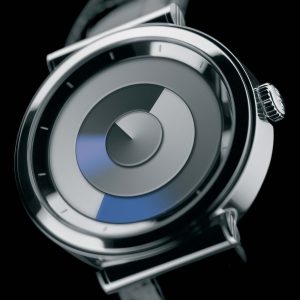
The watch featured an original time-display system for its era, using three concentric discs made of blue-tinted Zeiss crystal. Its design became the starting point for the collection of wristwatches that Lederer would develop in the years that followed. The model was awarded Best German Watch of the Year in 1996.
That same year, Hans Donner helped Lederer undertake a huge and highly significant project: the Brazil Countdown Monumental Clock, created to commemorate, on 22 April 2000, the 500th anniversary of the discovery of Brazil by Portuguese navigator Pedro Álvares Cabral.
None of the watchmakers approached about undertaking the project was willing to accept its complexity, with the exception of Lederer. Standing 14 metres high, 27 examples of the clock were produced and distributed throughout the country. They had to withstand the challenges of the Brazilian environment, including salty Atlantic air carried by the wind, frequent storms and intense heat.

The birth of BLU
Years later, in 2007, Lederer created his wristwatch brand BLU (Bernhard Lederer Universe) and presented the Majesty MT3 Tourbillon. It featured three tourbillons, two balance wheels and one semi-balance, as well as his first escapement developed entirely in-house. The model was awarded the prestigious “Most Admired Watch of the Year” at Asia’s largest collectors’ gathering, held in Kuala Lumpur.
In 2011, he surprised the watchmaking community with a new model, the Tourbillon Gagarin, created to commemorate the 50th anniversary of Russian cosmonaut Yuri Gagarin’s historic 108-minute space flight.

Among its most distinctive features was a flying tourbillon rotating counterclockwise and completing one revolution in precisely 108 minutes, together with a magnifying lens allowing the wearer to observe its mechanical complexities. Watch number one was presented as a gift to His Serene Highness Prince Albert II of Monaco on the occasion of his wedding. The model received worldwide recognition and several awards.
The pursuit of magnetic resistance
In 2016, Bernhard Lederer presented a revolutionary world first: a calibre with an extraordinarily low rate of magnetic interaction, capable of maintaining its precision even when exposed to a magnetic field of 100,000 Gauss.
Developed for the German Navy’s special bomb-disposal squad, the movement was certified according to the stringent NATO STANAG 2897 standard, with a magnetic signature of less than 5 nanotesla. This innovation made it the only watch to meet the strict requirements of the standard equipment used by Germany’s NATO special forces mine-clearance divers.

Central Impulse Chronometer
After a decade of meticulous development, Bernhard Lederer achieved what generations of watchmakers had dreamed of with his Central Impulse Chronometer: a revolutionary timepiece that redefines the precision, reliability and efficiency of mechanical wristwatches.
The CIC is the first chapter in the “Masters of Escapements” series, whose objective is to create a new escapement that is reliable, energy-efficient and suitable for high-end wristwatches.
The model builds upon the work of two of the most respected master watchmakers of the past: Abraham-Louis Breguet and George Daniels, with their natural escapement and independent double-wheel escapement respectively.
Following an approach similar to that of George Daniels, Bernhard Lederer positioned the two escape wheels at the end of two separate gear trains, each powered by its own barrel. However, the functionality and architecture of the escapement were redesigned to ensure maximum efficiency in delivering impulse to the oscillator.
In addition, each set of escape wheels is equipped with its own remontoir, a mechanism that rewinds a small spring every ten seconds, thereby ensuring a consistent flow of energy to the escapement.
The Central Impulse Chronometer escapement is based on a pair of escape wheels interacting with a specially designed titanium lever featuring a unique geometry optimised for efficiency.
The impulse positions, angles and contact times are engineered to drastically reduce friction and thereby increase the longevity of the calibre.
The sounds produced by the alternating double impulses and remontoirs give the CIC a unique and complex acoustic signature.
Entirely designed and manufactured by Lederer himself, every movement undergoes a meticulous hand-finishing process.
Alongside his technical mastery, Bernhard Lederer possesses a distinctive sensitivity for design, a quality in which he has repeatedly distinguished himself. The watch features a streamlined 44 × 12.2 mm round case. The bevelled hands combine leaf and baton forms, reinforcing Lederer’s aesthetic signature. Defying symmetry, the dial features a large small-seconds subdial positioned at 8 o’clock.
This innovative creation was awarded the Innovation Prize at the Grand Prix d’Horlogerie de Genève in 2021.
Following this prestigious award, Lederer decided to take the Central Impulse Chronometer project further and present it in a new 39 mm size, the dimensions of the models currently in his collection.
It was a new technical and aesthetic challenge, resolved with elegance. The new CIC 39 mm required a complete reinvention of the technical innovation and architecture of the CIC movement, from reducing the mechanism’s thickness by 18% to achieving perfect synchronisation of the seconds hand.
The model is presented in two limited editions of 20 pieces each, one featuring a white-gold case with a blue dial and the other a rose-gold case with a grey dial.
Triple Certified Observatory Chronometer
His latest major creation was the Triple Certified Observatory Chronometer, presented in 2024.
This new model represents another step forward in Lederer’s pursuit of mechanical accuracy. In addition to being COSC-certified, it has passed all the accuracy tests conducted by three of the world’s most prestigious observatories: Besançon in France, Glashütte in Germany and the Observatoire Chronométrique de Genève in Switzerland.
The initial test produced a remarkable maximum deviation of just +0.5 seconds per day across five positions, comfortably surpassing the permitted limit of eight seconds. With an average deviation of only 0.18 seconds per day, far below the permitted six seconds, this chronometer exemplifies the expertise of the German master craftsman.
These results are not merely numbers; they tell a story of painstaking engineering and an unrelenting pursuit of perfection.
Historically, precise timekeeping was essential for navigators plotting their course at sea, where every second mattered. A deviation of just one second could translate into a positioning error of almost 500 metres at the equator.
The implications are remarkable: a COSC-certified watch can, over time, allow deviations that could lead to calculation errors of up to 70 kilometres after ten days of navigation. The Triple Certified Observatory Chronometer overcomes such challenges with two remontoirs that ensure accurate timekeeping throughout the entire power reserve, eliminating the familiar variation in precision caused by the mainspring.
To further emphasise its connection with navigation, each watch bears an engraved compass rose showing the eight principal directions, revealing the edition’s limitation to just eight pieces. Each of the eight watches is individually marked with one of the cardinal directions.
The watch features a 44 × 12.2 mm steel case, the same dimensions as the CIC, and is water-resistant to 30 metres.
Inside is the impressive hand-wound CIC 9012.10.710 calibre, beating at 21,600 vibrations per hour and offering a 38-hour power reserve thanks to its double barrel. It incorporates two independent gear trains, two constant-force mechanisms and a dual system of independent escape wheels.
The dial, created by Lederer himself, displays the hours and minutes with arrow-shaped hands, together with an off-centred small-seconds subdial positioned at 8 o’clock.
The model won the Chronometry Prize at the Grand Prix d’Horlogerie de Genève in 2024.
In 2026, a variation of his Central Impulse Chronometer, the CIC Inverto Titanium 39, has been nominated in the Complication category at the Grand Prix d’Horlogerie de Genève.
The master of escapements
Throughout his career, Bernhard Lederer has demonstrated that watchmaking is about far more than measuring time. It is an art, a mechanical challenge and an expression of human mastery.
His creations, from the Central Impulse Chronometer to the Triple Certified Observatory Chronometer, have not merely rewritten the rules of precision; they are helping to define a new chapter in the history of modern chronometry.






One Response
Alfonso, great piece! You captured Bernhard Lederer’s story beautifully, from the apprenticeship to the Triple Certified Observatory Chronometer. He deserves far more recognition among collectors of independents. Congratulations!