

Founded by Svend Andersen and Vincent Calabrese in 1985, the AHCI gave isolated creators a shared stage, a measure of legitimacy, and direct access to the public—helping turn endangered craft into one of modern watch collecting’s most influential movements.
The most radical innovation of the independent-watchmaking renaissance was not an escapement, a tourbillon, or a new material. It was a shared exhibition stand.
That sounds almost absurd today. Collectors now wait years for watches signed by living makers. Auction catalogs treat early independents as a distinct historical category. A creator working with a few benches, a conventional lathe, and an annual output measured in dozens can attract more attention than a manufacture launching an entire collection.
But before independent watchmaking became a collecting obsession, its most basic problem was visibility. A solitary watchmaker could invent brilliantly and still remain commercially invisible. The AHCI changed that equation.

A Renaissance Needed an Organizer
The Académie Horlogère des Créateurs Indépendants is often described as a guardian of traditional watchmaking. That is true, but incomplete. Preservation was only half its achievement.
The AHCI also created a system through which unconventional work could be seen, compared, discussed, and eventually trusted. It did not manufacture watches. It did not impose a house style. It did not turn its members into employees. It organized attention.
That distinction matters. Mechanical watchmaking in the early 1980s was not simply losing a technology contest to quartz. Its entire cultural justification was under pressure. If accuracy, price, and convenience were the only criteria, the electronic watch had already won. Hand-made mechanical watchmaking needed a different argument: authorship, ingenuity, continuity of craft, and the emotional force of a machine conceived by an identifiable person.
The AHCI helped make that argument public.
Its importance, then, is not that every great independent belonged to it, or that every member became historically significant. The academy matters because it gave scattered resistance the structure of a movement.
The Problem Before the AHCI: Talent Without a Platform
Independent watchmakers existed long before the AHCI. George Daniels was constructing complete watches under his own name in Britain. Svend Andersen had left the world of established Geneva watchmaking to pursue automata, calendars, and unusual commissions. Vincent Calabrese was treating movement architecture as something that could be liberated from the usual round plate-and-bridge arrangement.
What these makers lacked was not imagination. It was leverage.
A large brand could buy advertising, secure a prominent fair location, maintain distributor relationships, employ a press department, and reassure buyers with an international service network. An individual watchmaker might have one exceptional object and no practical way to place it before the people capable of understanding or buying it.
This created a brutal paradox. The makers most able to prove that mechanical horology still had creative life were also those least equipped to command public attention.
The solution devised by Andersen and Calabrese was collective visibility without collective authorship. Each creator would remain independent, but the group would share the cost, credibility, and traffic of appearing together.
That was the organizational breakthrough.
From an Appeal to an Academy
According to the AHCI’s official history, Andersen and Calabrese circulated an “Appeal to all Artists and Craftsmen of Watchmaking” to specialist publications in 1984. The proposal was practical: organize collective exhibitions where the public could encounter both the objects and the people who made them.
The first exhibition followed in the summer of 1985 at the watch museum in Le Locle. The founders appeared alongside Giovanni Pozzi, Charles Hirschy, Kurt Schaffo, Joseph Snétivy, and the ultra-thin specialist La Montre Extra Plate. Public and industry interest persuaded the participants that the shared-exhibition model worked. The community itself was formally established by Andersen and Calabrese in 1985. AHCI — official history
The decisive move came in 1987. Under the AHCI name, the academy presented a collective stand at the European Watch, Clock and Jewellery Fair in Basel, the event later known as Baselworld. The AHCI records 12 watchmakers from six nationalities at that exhibition. AHCI — official history
This was more than a larger room.
Basel placed the independents inside the industry’s main commercial theater. A visitor could move from polished corporate displays to a stand where the person behind the watch might also be the designer, constructor, finisher, assembler, and salesperson. The scale was smaller, but the authorship was unusually concentrated.
One of Svend Andersen’s remarks captures the difference: “At the AHCI you can touch the watchmaker who makes your watch.” AHCI — members directory
For collectors accustomed to buying a brand’s history, the possibility of meeting the maker changed the emotional transaction. A watch could now be understood not merely as a product from a manufacture, but as the outcome of a particular mind, workshop, and set of compromises.
How the AHCI Actually Organized a Renaissance
The word “organized” can suggest central control. That is not what happened. The AHCI’s influence was closer to cultural infrastructure.
1. It aggregated attention
One unknown watchmaker is easy to overlook. A stand filled with radically different watches by creators from several countries becomes a destination.
The collective format multiplied press value. A journalist could discover several stories in one visit: an escapement experiment, an automaton, a sculptural clock, an unusual calendar, or a movement built around an eccentric display. The AHCI did not need the advertising budget of a conglomerate because its members generated a concentration of novelty.
2. It converted isolation into peer context
Independent watchmaking can become intellectually lonely. A creator working outside a manufacture has freedom, but fewer colleagues with whom to test ideas, compare methods, or discuss suppliers and clients.
The academy created a peer environment without erasing rivalry. It allowed a watchmaker to remain singular while being seen as part of a serious field.
3. It supplied a credibility signal
For an early collector, buying from an individual maker involved obvious risks. Would the watch be delivered? Could it be serviced? Was the mechanism genuinely original? Would the workshop exist in ten years?
AHCI membership could not eliminate those questions, but it reduced the informational gap. The academy itself describes admission as a recognition of quality, ingenuity, and creativity—an “AHCI test.” That is not the same as an independent laboratory certification, but it is a form of peer and institutional validation. AHCI — recognition
4. It made the maker part of the object
The AHCI stand normalized direct conversation between creator and client. That became one of independent watchmaking’s strongest advantages.
A collector could ask why a bridge had a particular shape, why a remontoir was chosen, which components were made internally, or how future servicing would work. The answer did not need to travel through several layers of marketing.
This directness later became central to the appeal of independent watches. The AHCI recognized its value before “meet the maker” became an industry event format.
5. It permitted disagreement
Perhaps the academy’s greatest strength is that AHCI watches do not look like AHCI watches.
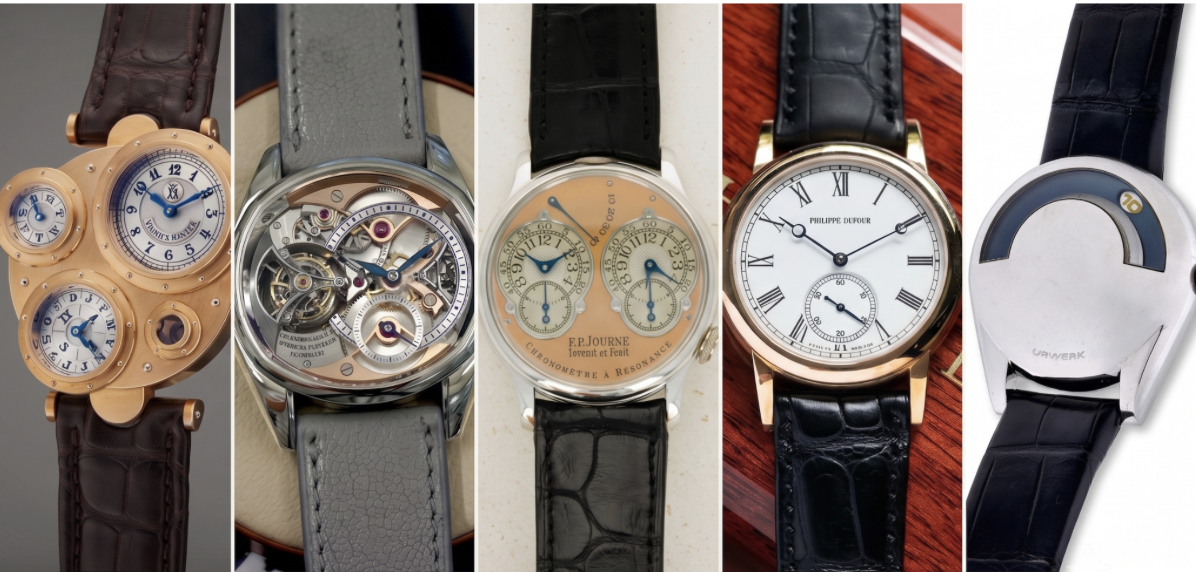
There is no mandatory dial layout, case shape, finishing language, or favored complication. Philippe Dufour’s classical restraint, Vianney Halter’s retro-futurism, Konstantin Chaykin’s animated displays, Kari Voutilainen’s guilloché and movement finishing, and Vincent Calabrese’s architectural provocations can coexist because the institution protects independence rather than visual consistency.
That made the AHCI a framework for difference, not a school with a fixed doctrine.
The Disruptors: Different Ways to Challenge the Industry
The academy’s history becomes clearer when we stop treating “independent” as a style and examine the kinds of disruption its members represented.
Vincent Calabrese: movement architecture as rebellion
Calabrese’s work questioned why a movement had to be hidden, round, and visually secondary to the case and dial. His linear movement concept, created in the 1970s and later associated with Corum’s Golden Bridge, turned the caliber into the central visual structure of the watch. Corum itself describes the original in-line movement as Calabrese’s creation. Corum — Golden Bridge history
The disruption was both technical and philosophical. Instead of decorating a conventional mechanism, Calabrese reorganized the mechanism so that construction and spectacle became the same thing.
As an AHCI co-founder, he also understood that technical originality was commercially powerless if nobody could encounter it.
George Daniels: the individual as a complete manufacture
Daniels offered a different challenge. He revived the ideal of the watchmaker complet—a maker capable of conceiving and constructing nearly the entire watch—while also developing an escapement intended to address a longstanding technical weakness.
In the conventional Swiss lever escapement, impulse involves sliding contact at the pallet stones. Daniels’ Co-Axial arrangement separates locking from impulse and delivers impulse with more radial action, reducing sliding friction and the escapement’s dependence on lubrication. The important point is not that it made a mechanical watch “better than quartz.” It attacked a mechanical problem on mechanical terms.
The AHCI records Daniels as a member from 1987 until his death in 2011, and notes that the Co-Axial concept was unveiled in 1976 before appearing in an industrially produced Omega watch in 1999. AHCI — George Daniels
Daniels demonstrated that an independent could influence industrial watchmaking rather than merely retreat from it.
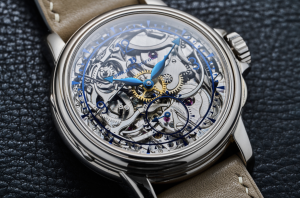
Philippe Dufour: craft as the innovation
Dufour’s disruption is easy to misunderstand because his watches often look classical. Nothing about the Simplicity shouts for attention. That restraint is precisely the point.
After producing five grande sonnerie pocket watches for Audemars Piguet, Dufour miniaturized the complication for his own wristwatch, presented under his name in Basel in 1992. The later Duality used two escapements linked through a differential, adapting a principle associated with double-balance school watches to the wrist. The Simplicity then made finishing, proportion, and traditional movement construction the main event.
The AHCI lists Dufour as a member since 1987 and records the grande sonnerie, Duality, and Simplicity as the key progression of his own brand. AHCI — Philippe Dufour
Dufour proved that disruption does not require futuristic styling. In an industrial age, executing familiar techniques with extreme manual control can itself be radical.
François-Paul Journe: from artisan to manufacture without surrendering authorship
Journe joined the AHCI in 1988, before presenting the F.P. Journe wristwatch collection in 1999. His importance lies partly in scale: he showed that a watchmaker-led company could grow beyond one-man production while keeping invention visibly connected to the founder. AHCI — François-Paul Journe
Technically, the early Tourbillon Souverain used a remontoir d’égalité—a small secondary energy store that is periodically recharged by the mainspring train and delivers more consistent impulses downstream. The Chronomètre à Résonance placed two independent oscillators in close proximity, seeking to couple their rates through the minute vibrations transmitted within the watch—a centuries-old chronometric principle translated into wristwatch form. F.P. Journe describes the model as the first resonance chronometer in wristwatch form. F.P. Journe — Chronomètre à Résonance
Journe’s commercial success also changed expectations. The independent did not always have to remain obscure, artisanal in the narrowest sense, or incapable of building a recognizable manufacture.
Vianney Halter: the future no longer had to look polished and corporate
When Halter introduced the Antiqua perpetual calendar in 1998, its riveted case, multiple porthole-like displays, and deliberately aged surfaces presented complication through fictional archaeology. The AHCI describes it as a “relic of the future” and dates Halter’s membership to 2000. AHCI — Vianney Halter
The Antiqua mattered because it rejected the assumption that serious complications required conservative visual codes. It made authorship visible from across the room.
That lesson shaped a later generation of independents: technical legitimacy and imaginative world-building were not opposites.
Why Collectors Care
Collectors care about the AHCI because it sits near the origin of several values that now define independent-watch collecting.
First is authorship. The collector can trace a design decision to a person rather than to an anonymous product committee. That does not automatically make the decision good, but it makes it intelligible.
Second is scarcity with a reason. Low output is sometimes used as a marketing device. In genuine small-workshop watchmaking, it can instead result from the hours required for construction, adjustment, hand-finishing, and assembly. Scarcity is most convincing when it is a consequence of method.
Third is divergence. The large groups are capable of exceptional watchmaking, but their products must usually fit brand codes, production plans, warranty systems, and commercial categories. An independent can decide that a watch needs two balances, a wandering display, a visible remontoir, an unconventional case, or no obvious market segment at all.
Fourth is proximity. The AHCI institutionalized the possibility of meeting the creator. For many collectors, the correspondence, workshop visit, discussion of a commission, and later service history become part of the watch’s provenance.
Finally, there is historical recognition. The market now prices certain early independents as major horological figures. For example, a 1999 F.P. Journe Souscription Tourbillon No. 1 sold for CHF 3,539,000 at Phillips in 2021, while a Philippe Dufour Duality sold for $2,056,500 at Phillips in 2024. These results do not establish intrinsic value, but they show how dramatically the collecting hierarchy has changed. Phillips — F.P. Journe Souscription Tourbillon; Phillips — Philippe Dufour Duality
The warning is obvious: auction success can attract buyers who care more about liquidity than horology. Yet even speculation confirms a cultural reversal. Makers once considered commercially marginal now influence how the top end of the market defines importance.
The Technical Perspective
The AHCI is not a technical standard. It does not certify rate performance like the COSC, define origin and finishing rules like a hallmark, or require every member to make every component under one roof.
Its technical contribution is environmental.
By creating visibility for small makers, the academy improved the odds that unusual mechanisms would survive long enough to be studied, financed, and refined. That matters because experimental watchmaking is expensive and slow. A novel escapement can fail through geometry, materials, lubrication, shock sensitivity, or adjustment. A striking mechanism can work on the bench and disappoint once cased. A sculptural display can consume too much energy. Innovation needs clients willing to support development and a public capable of understanding why the attempt matters.
The range of AHCI work also broadens the meaning of technical merit. This is why reducing independent watchmaking to “handmade” is inadequate. A watch can be independently conceived yet rely on specialist suppliers. It can use an existing base caliber but transform its display or complication. It can be vertically integrated or built through a network of craftspeople. The proper questions are more precise: Who conceived the mechanism? Which parts are proprietary? What was modified? Who performs the finishing and adjustment? Can the maker explain the construction? Is the watch serviceable?
The AHCI’s greatest technical service was to create a stage on which those questions could be asked directly.
The Critical View
Admiration should not become mythology.
The AHCI did not single-handedly revive mechanical watchmaking. Brands, retailers, auction houses, specialist journalists, restorers, schools, suppliers, and collectors all contributed. Nor does the academy contain the entire independent field. Its current directory is broad, with creators from Europe and Asia, but many influential contemporary independents operate outside it. AHCI — members directory
Membership should therefore be read as a meaningful signal, not a universal ranking.
There is also no single, publicly legible technical benchmark behind the AHCI name comparable to a chronometry certificate. Creativity and quality require judgment, and judgment can be subjective. A collector must still evaluate movement construction, originality, finishing, reliability, service arrangements, and the maker’s financial durability.
The direct relationship can create its own problems. A brilliant watchmaker is not automatically an efficient administrator. Small teams can struggle with schedules, communication, spare parts, and succession planning. The very scale that makes a watch personal can make after-sales service fragile.
The market adds another distortion. Once independents become trophies, price can outrun understanding. Early work is relabeled “historically important,” every low production number becomes a headline, and access migrates from curious enthusiasts to a narrow circle of highly capitalized clients.
There is a paradox here. The AHCI helped democratize visibility for makers, but the success of the movement has made many of its most celebrated watches less accessible to ordinary enthusiasts.
That is not an argument against the academy. It is a reason to protect its discovery function. The AHCI is most valuable when it helps the public encounter the next difficult, unproven creator—not only when it celebrates names the market has already canonized.
Conclusion: The AHCI Organized Attention—and Changed Horology
The AHCI’s achievement was to understand that endangered craft could not survive on skill alone. It needed presentation, community, validation, and contact with buyers.
Andersen and Calabrese did not ask independent watchmakers to become alike. They asked them to appear together. That subtle distinction allowed the academy to create collective power without sacrificing the individual authorship that made the work valuable.
The results can be seen in the careers that passed through its exhibitions: Daniels’ escapement thinking, Calabrese’s liberated architecture, Dufour’s uncompromising traditional execution, Journe’s chronometric systems, Halter’s alternative visual universe, and the increasingly international membership that followed.
Official recognition eventually caught up. The GPHG awarded the AHCI its Special Jury Prize in 2010 and honored co-founders Svend Andersen and Vincent Calabrese with the same prize in 2023. GPHG — winners archive
But the academy’s deeper legacy is not a trophy. It is the now-familiar idea that a watchmaker can stand in front of a small table, place an unfamiliar mechanism beneath a loupe, and compete for attention with the largest companies in Switzerland.
The future will test that model. Social media gives makers instant reach, but reach is not the same as credibility. Crowdfunding can finance production, but it cannot guarantee sound construction. Auction prices can confer status, but they cannot identify the next important idea.
The AHCI still has a role if it remains what it was at its best: a discerning bridge between unknown creators and a public willing to look closely.
It did not own the renaissance of independent watchmaking. It gave the renaissance a meeting place.
What was the AHCI’s most important contribution to independent watchmaking?
- Preserving traditional craft
- Giving individual makers collective visibility
- Encouraging mechanical experimentation
- Creating direct relationships with collectors
Vote and tell us which AHCI member best represents your choice.
Key Facts
- AHCI: Académie Horlogère des Créateurs Indépendants.
- Founders: Svend Andersen and Vincent Calabrese.
- Initial appeal: Sent to specialist watch publications in 1984.
- Community founded: 1985.
- First collective exhibition: Watch museum in Le Locle, summer 1985.
- Basel debut under the AHCI name: 1987, with 12 watchmakers from six nationalities.
- Core purpose: Promote independent watch- and clockmakers while preserving creative and craft autonomy.
- Not a technical certificate: Membership signals peer recognition but does not replace due diligence on construction, originality, performance, and service.
- GPHG recognition: Special Jury Prize for the AHCI in 2010; Special Jury Prize for Andersen and Calabrese in 2023.
- Enduring influence: Shared visibility, direct maker-collector contact, and legitimacy for unconventional horology.