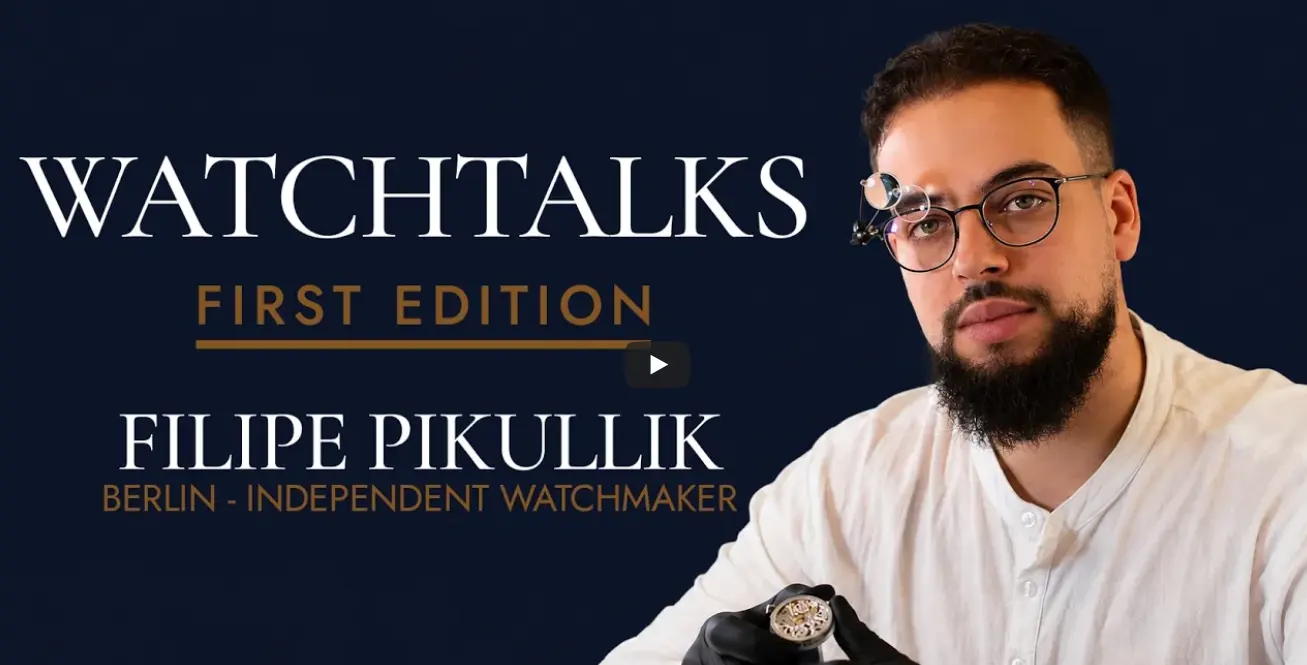


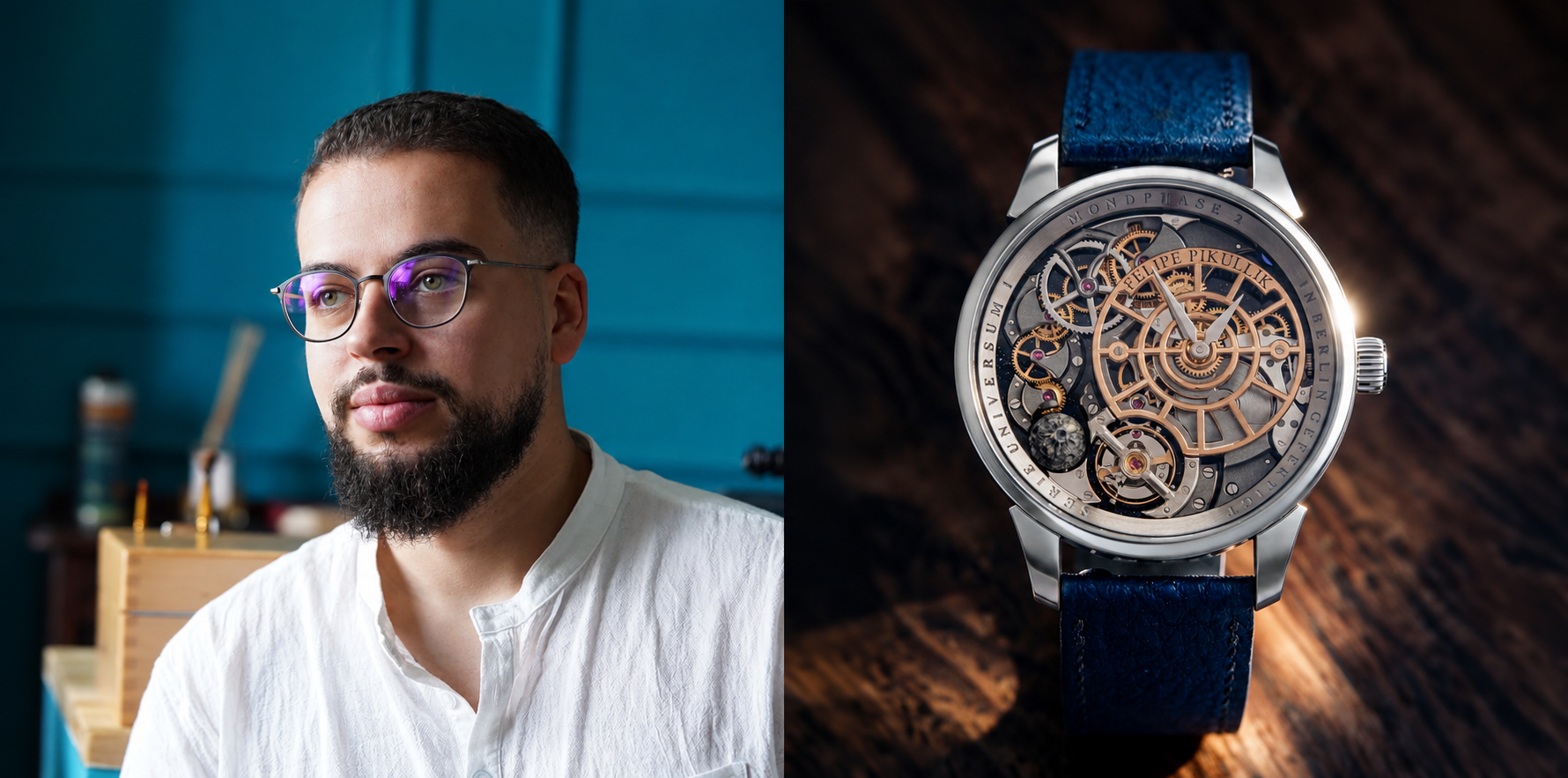
Some watches you study. Others stop you in your tracks. My path to Felipe Pikullik began with the second kind.
The first time I saw a piece from his Skeleton series, I could not stop looking at it. The movement was not hiding behind a dial. It was the dial. Every bridge, every engraved surface and every sharp bevel seemed to move with the light.
Skeletonization can easily feel like an engineering exercise, a movement cut open simply to show what is inside. This felt different. It felt alive, as if the mechanics had been composed rather than merely exposed.
I walked away with a name I could not get out of my head, and the certainty that I needed to see more.
Love at First Sight in Avignon
Not long after, my wife Orli and I were vacationing in France, and I arranged to meet Felipe Lukas Manzano, the brand manager of Felipe Pikullik, in the city of Avignon. My intention was modest. I only wanted to see a piece in person.
Felipe Lukas brought the HTH, and I fell in love immediately. No photograph had prepared me for the depth of the finishing or for the way the movement seems to breathe on the wrist.
Then, almost casually, he showed me the renders of a watch that had not yet been revealed: what would soon be known as the Moonphase 2. It was love at first sight. My wife looked at me and said, “You are getting that one.” She is, I confess, a wonderful enabler.
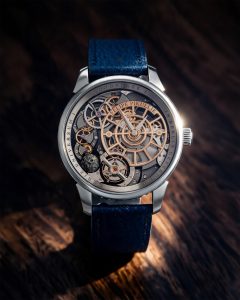
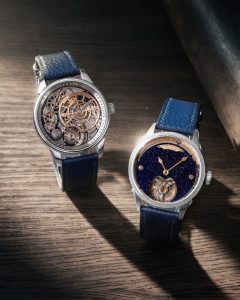
That meeting became far more than a viewing. In the months that followed, I ordered three pieces from the brand: the new Sternenhimmel with the new movement in green aventurine, the FPSK2026, and the MP2 in steel. I expect to receive them in 2027 and 2028, and I already know the wait will be worth every single day. Felipe Lukas deserves enormous credit for all of this. He represents the brand with warmth, patience and real knowledge, and he made me feel like part of the family from the first handshake. I will see both Felipes again soon during their upcoming tour of the United States, and I could not be more excited.
To understand why these watches move people the way they do, you have to understand the man whose name is on the dial. I recently had the privilege of asking Felipe Pikullik about his story, his craft and where he is going next.
A Clock That Only Worked Face Down
Felipe’s defining moment came long before he founded a brand. As a child, he watched a documentary about a watchmaker and was captivated by the idea that so many tiny parts could work together to measure time.
Craftsmanship already ran in the family. His father is a craftsman, and his grandmother owned an old mechanical alarm clock that kept stopping. Strangely, it only seemed to run when placed face down. Young Felipe made it his mission to understand what was wrong and fix it himself. He succeeded, and that same alarm clock still sits on his desk today.
That curiosity never left him. In 2017, at just 23 years old, he founded his brand in a living room in Berlin. He had little in the way of resources or infrastructure. What he did have, in his words, was “an absolute belief that if something was technically possible, then the obstacles between me and that goal could somehow be overcome.”
Two Masters, Two Lessons
Two watchmakers shaped Felipe’s foundation. From Rolf Lang, he gained a deep respect for historical mechanics, traditional tools and classical Saxon watchmaking, especially chronometry and restoration.
One moment with Lang stayed with him. Lang handed him a broken pocket watch and told him, in essence, to come back when it looked and worked like new. It was a hard lesson and a lasting one. If he can imagine something, or if someone has achieved it before, it is possible. The only question is whether he is prepared to overcome every obstacle along the way.
From Stefan Kudoke, Felipe took much of his passion for skeletonization and hand engraving. Kudoke showed him what it truly means to be independent, and how an industrial base movement can be transformed by hand into something entirely individual. That marriage of technical watchmaking and artistic expression would define the direction of Felipe’s own work.
Why Berlin
For Felipe, Berlin was never a strategic calculation. It is home. His family and friends are there, so the choice was personal and natural.
But Berlin is not Glashütte or Le Locle. In the early years there was no established ecosystem of suppliers, specialists and watchmakers to lean on. In Switzerland, he points out, you are surrounded by generations of accumulated knowledge and by companies devoted to nearly every individual process in making a watch. In Berlin, much of that simply does not exist, and credibility has to be earned without the halo of a famous Swiss address.
Over time, Felipe came to see that distance as an advantage. It forced the team to become resourceful, to solve problems themselves and to build capabilities in house that others would outsource. It also gave him the freedom to build his own system rather than slot into an existing one. His ambition is to establish a distinct approach to education, development and production right there in Berlin, a city that naturally attracts young international talent.
Would a Swiss address have made things easier? Almost certainly, at least at the start. “But ultimately, an address cannot make a great watch,” he says. The product, the craftsmanship and the integrity of the work have to speak for themselves. Being from Berlin is now central to the brand’s identity, and Felipe would not trade it for anything.
A Kinetic Sculpture on the Wrist
From German watchmaking, Felipe consciously carries forward an uncompromising approach to quality and precision, a seriousness toward the craft he values enormously. Where he allows himself freedom is in the visual language. German watches can be architecturally restrained. His are expressive.
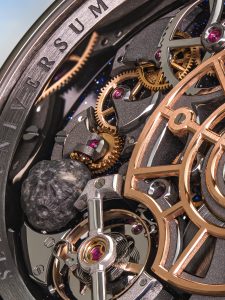
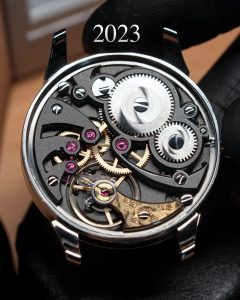
Through extensive skeletonization, organic tremblage surfaces, hand engraving and bold contrasts between matte finishes, polished bevels and black-polished components, the mechanics themselves become the art. A movement, he believes, does not have to hide behind a dial or be seen purely as an engineering object. It can feel alive, “almost like a kinetic sculpture on the wrist.” Anyone who has seen one of his watches in the metal knows exactly what he means.
The FPA1: A Blank Sheet of Paper
Felipe spent roughly ten years working with movements such as the Unitas: modifying them, skeletonizing them, finishing them and eventually integrating his own complications. That decade taught him not only what works, but where the limits of an existing architecture begin.
When he felt ready for the next step, the question was bigger than his own skill at the CAD screen or the bench. The whole workshop had to be able to produce, finish, assemble and regulate new components reliably, every day. From the first lines on screen to a working prototype took about two to three years, all of it alongside normal production. Asked how many sleepless nights it cost, he answers simply: “Probably all of them.”
The result is the Felipe Pikullik Architecture 1, or FPA1. Its greatest gift is freedom. With a base movement, the gear train, barrel and escapement are already placed for you. With the FPA1, Felipe started from a blank sheet and could design the movement and the watch as one object. He sees it not as just another caliber, but as a foundation for new watches and complications in the brand’s own language.
Look at the Internal Angles
If you want to understand how a Felipe Pikullik watch is made, he suggests a loupe and a very specific place to look: the internal angles of the hand-beveled bridges.
These are tiny details, easy to miss. Yet a perfectly sharp internal angle cannot be produced by a CNC machine and then mechanically polished. It must be formed and finished by hand, with enormous patience, control and experience. These details are not meant to impress from across the room. They reward the collector who leans in and starts exploring, and that is when the hundreds of hours of handwork reveal themselves.
Building the Next Generation
The team in Berlin is young, and applications arrive in steady numbers. What Felipe looks for most is passion, commitment and the willingness to keep learning. He believes deeply in the traditional master and apprentice model, where knowledge passes from one person to another through real work at the bench.
Some roles require the foundation of a formally trained watchmaker. In hand-finishing, however, attitude and patience matter just as much. “You can teach someone a technique,” he says, “but you cannot easily teach them to care about the final half of a millimeter that nobody else might notice.”
For Felipe, the manufacture is not only where watches are made, but where knowledge is preserved and handed down. He designs assemblies so that younger watchmakers can understand why they work and eventually master them. Delegation, in his view, should never mean handing off a repetitive task. It should mean transferring knowledge and responsibility. If the know-how lives only in his own hands, he says, he has not built something that can endure. The real achievement is when it belongs to the next generation.
For the Curious Collector
Who is a Felipe Pikullik watch for? Anyone genuinely fascinated by honest watchmaking and uncompromised craftsmanship. His collectors tend to be curious. They want to know how something was made, why a construction was chosen and where the human hand shows in the finished piece. For many, the relationship with the people behind the watch is part of the joy. If someone simply wants an instantly recognizable status symbol, Felipe is the first to say his brand is probably not the right place, and he is comfortable with that.
He has a special fondness for American collectors. Many have researched his work in depth before they ever meet him, so conversations go deep right away. The interaction is warm, direct and uncomplicated, and people want to know not only the watch but the person making it. In his experience, European collectors can be a little more cautious with something new, while many Americans are especially open to discovering young independent makers. As a Miami collector, I can tell you that openness is very real.
As for awards, recognition from institutions like the GPHG is meaningful to him, and he appreciates being counted among so many important names. But he refuses to let awards define the value of the work. The most meaningful validation is seeing one of his watches on the wrist of someone who truly understands what went into it.’
What Comes Next
Felipe has learned not to plan too rigidly ten years ahead. There is only one thing he is certain of: “I will build watches for the rest of my life.” Whether that means one extremely complicated watch a year or a manufacture producing more than a thousand pieces, he is open to the journey, as long as quality and craftsmanship are never compromised. Healthy, natural growth matters more to him than any production number.
With the FPA1 and the three-dimensional moon phase of the FPMP2, the brand now has architectures that open the door to new complications. He is especially drawn to complications that display the passage of time in unconventional ways, and he insists each one must have a reason to exist, both mechanically and visually. He cannot reveal what is coming yet, only that it will continue the same language: traditional mechanics and handcraft, expressed through an almost kinetic approach to movement architecture.
Above all, he wants the first reaction to his watches to be emotional before it is technical. A watch should never feel like a sterile industrial object. It should carry traces of the human hand everywhere, because behind each one is a team in Berlin pouring in time, concentration and passion. If a collector can feel that connection, he says, then the most important thing has been achieved.
Closing Thoughts
I felt that connection the first time I saw a Skeleton series piece, and again in Avignon when Felipe Lukas placed the HTH in my hands. Felipe Pikullik is that rare maker whose ambition is matched by his humility, and whose brand is in the care of people who genuinely love what they do.
My three pieces will arrive over the next couple of years, and I will be counting the days. In the meantime, I look forward to welcoming both Felipes during their upcoming tour of the United States. If you have the chance to meet them, take it. And bring a loupe.