

An independent initiative wants to put the artisan back at the center of watchmaking. Its first New Talent Award has just proven the model works.
There is a comfortable story the watch world likes to tell about itself. The genius at the bench, alone with his loupe, inventing everything from scratch. It makes for beautiful advertising. It is also, almost always, untrue.
Every finisher who can draw a perfect anglage learned it from someone who learned it from someone else. Every machinist who can hold a tolerance by feel inherited that feel. Watchmaking is not a collection of techniques. It is a chain of hands, and a chain is only as strong as its weakest link. When one link is never passed on, it disappears.
That is the idea at the heart of Tad Kozh, a Swiss non-profit association founded by Baudouin and Alix van Es, and the thesis this article will follow: a craft survives only if someone has a reason, and the means, to receive it.
A Name That Carries a Position
Tad Kozh means “grandfather” in Breton. It is a deliberate choice, and not a nostalgic one. The image is not of an old man behind glass. It is of knowledge that travels from one generation to the next, gaining meaning on the way.
The founders come to this from the media side. In 2019 they launched Tourbillon Watch, a platform built around the people behind haute horlogerie rather than the objects alone. Years of telling those stories made one thing hard to ignore: the industry celebrates heritage loudly, yet many of the artisans who carry it remain largely invisible, and the young ones who want to follow them often have no clear path to independence.
Tad Kozh is their answer. Not another story about the problem, but a mechanism to address it.
Two Ideas, One Loop
The model rests on two components that feed each other.
The first is a pair of limited editions each year. Each one is a collaboration between a watch brand and an artisan working in a métier d’art the brand has never explored. The constraint matters. It pushes the house out of its comfort zone and gives the artisan real creative standing. The artisan studies the brand’s identity, proposes directions, and works with the house as a co-creator rather than a subcontractor. The result is closer to a dialogue between equals than a commission.
These editions are small, between five and ten pieces each, and offered by subscription. That format creates something rare in this industry: a direct line between collector and maker. Whoever buys one of these watches knows who shaped it, which techniques were used, and what story sits behind it.
The second component is where the proceeds go. The profits from those sales finance the Tad Kozh New Talent Award, which supports two young watchmakers every year on their way to independence. The collector’s purchase and the artisan’s visibility become the fuel for the next generation. Creation funds transmission, and transmission produces the next creators.
It is a simple loop, which is probably why it is convincing.
Equipping, Not Just Encouraging
Plenty of awards celebrate promise. Fewer give a young watchmaker the means to work. This is where the New Talent Award stands apart, because what it offers is concrete.
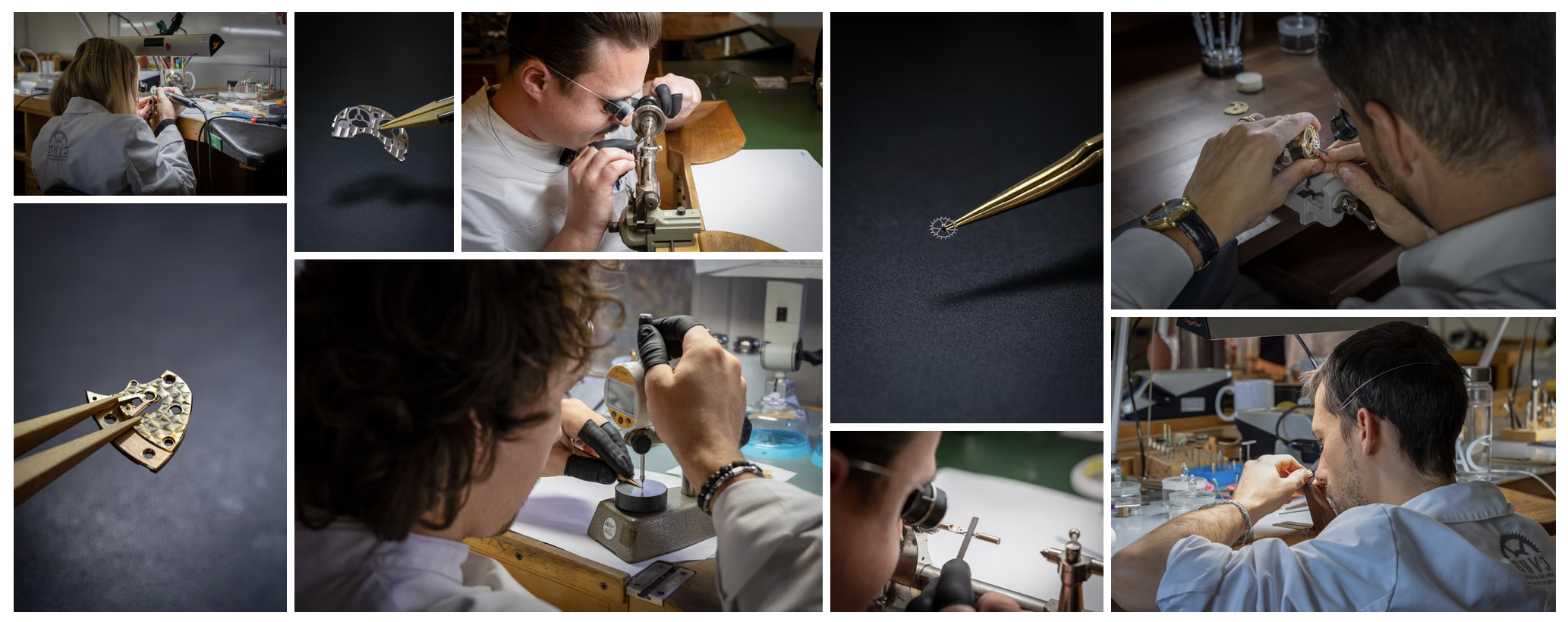
The winners receive a Tour 70 and a Hauser-type jig borer, the kind of machines that define what an independent workshop can actually produce. They benefit from advanced training on those machines by Luc Monnet, a Meilleur Ouvrier de France. And for 2026, they are mentored on both the technical and business sides by Jean-François Mojon and Pietro Tomajer, two names that carry real weight in independent watchmaking.
That combination answers the three questions every aspiring independent faces: how do I get the tools, how do I master them, and how do I turn skill into a viable business? Most careers stall on at least one of the three.
The eligibility is deliberately open. Candidates had to be between 18 and 35, holding a watchmaking diploma, or self-taught with a portfolio that proves the work. They had to want to go independent and to showcase machining or finishing techniques in their creations, whether watches, clocks, pendulums, or technical constructions.
A Jury That Knows the Bench
An award is only as credible as the people judging it. The jury is chaired by Marc-André Deschoux and brings together recognized names from independent watchmaking: Alexandre Ghotbi, Roy Davidoff, Guillaume Tetu, Hervé Schluchter, Luc Monnet, and Emilien Reverchon.
The selection process reflects the same logic. Candidates submit a file describing their professional project and the machining or finishing techniques they want to champion. The finalists are then invited to Switzerland for a one-day practical test. The final evaluation weighs technical quality and mastery of the gesture. In other words, the jury does not only read what a candidate says about their hands. It watches them work.
The First Edition: What Actually Happened
A model is only a hypothesis until someone tests it. The first edition of the Tad Kozh New Talent Award has now taken place, and the numbers say something about the appetite for this kind of opportunity.
The call for applications brought in 16 candidacies from 11 different nationalities. For a first edition, launched by a young association with no track record to lean on, that spread is telling. The need for a path to independence is not a local concern. It is shared by young watchmakers across borders.
The jury selected six of those applications. On October 3, the final took place in Geneva, where the selected candidates were judged on their technical quality and on their mastery of the gesture.
The two winners of this first edition are Thibault Claeys and Michael Rose.
Behind those two names is the whole point of the project. Two young watchmakers now have a route toward independence that did not exist a year ago, with the machines, the training, and the mentors to walk it.
The Quiet Argument Underneath
Step back, and Tad Kozh makes an argument that goes beyond one association.
It suggests that a collector is not only a buyer but a participant in a lineage. That a limited edition can be more than a scarce object, that it can be a funding mechanism for the people who will make tomorrow’s watches. And that the traditional hierarchy, where the brand’s name is on the dial and the maker’s name is nowhere, is a choice, not a law of nature.
None of this requires the industry to abandon what it does well. The maisons keep their identity. The collectors keep their pleasure. What changes is the direction of the flow: instead of value moving only toward the brand, a share of it travels back toward the hands that made it possible.
Why It Matters Now
Watchmaking has never lacked admirers. What it needs is more people able to practice it independently, with proper machines and proper guidance. Skills that are not used are lost, and workshops that never open cannot teach anyone.
The founders say it themselves: their aim is to form independent creators able to perpetuate and reinvent know-how, not executants. That distinction is the whole project in one sentence.
So the question Tad Kozh puts to the watch world is a practical one. If you love this craft, what are you doing to make sure someone can still practice it in thirty years?
For some, the answer will be buying a piece that funds a young watchmaker. For others, mentoring. For young watchmakers themselves, it will be applying to the next edition.
Nobody makes a watch alone. The ones worth wearing never were.
More information on the project and the New Talent Award is available at tadkozh.com.