

The Other Blancpain
Ask most collectors about Blancpain today and within a minute the conversation turns to water. The Fifty Fathoms, introduced in 1953 and arguably the first modern dive watch, has become the brand’s identity. The 2023 Blancpain x Swatch Scuba Fifty Fathoms then carried that story to an audience that had never heard of Villeret or Le Brassus.
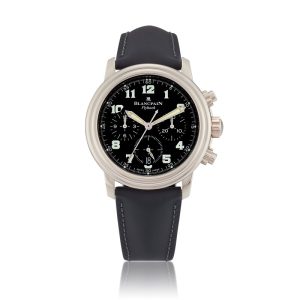
The Fifty Fathoms deserves its reputation. But it has crowded out a chapter of Blancpain history I think is just as important: the dress watches, complications and chronographs the brand made in the late 1980s and 1990s. My Léman Flyback Chronograph, reference 2185F, comes from that era, and it is the reason I started paying attention to it.
A Name Saved for CHF 22,000
Blancpain traces its roots to 1735, when Jehan-Jacques Blancpain began making watches in Villeret, in the Swiss Jura. That date gives it the claim of oldest watch brand in the world. Two centuries later it nearly disappeared. By the late 1970s, as cheap quartz movements swept the market, Blancpain had been folded into a larger Swiss group and its production had effectively stopped.
In 1983, Jean-Claude Biver and Jacques Piguet bought the rights to the Blancpain name, reportedly for about CHF 22,000. Piguet ran Frédéric Piguet, one of the finest movement makers in the Vallée de Joux, and the brand moved to Le Brassus, beside his workshops. Biver brought the vision and the marketing. Piguet brought the watchmaking.
Their bet was counterintuitive. At the height of the quartz crisis, they built a brand on traditional mechanical watchmaking, under a now-famous promise: there had never been a quartz Blancpain since 1735, and there never would be. Through the 1980s they released six masterpieces of watchmaking: an ultra-thin, a complete calendar with moon phase, a perpetual calendar, a split-seconds chronograph, a tourbillon and a minute repeater. In 1991 they combined all six in the 1735, at the time one of the most complicated wristwatches ever made.
The Swatch Years
The revival worked well enough to attract the industry’s biggest buyer. In 1992, SMH, the group that became Swatch Group, acquired Blancpain, reportedly for around CHF 60 million. Biver stayed on to run the brand and became part of the group’s leadership.
The sale did not dilute what Blancpain made. Through the 1990s it kept producing classically proportioned watches around serious movements, most of them from Frédéric Piguet, which also joined the group and was later merged into Blancpain itself. For collectors, this is the sweet spot: watches finished like independent pieces, built with the stability of a major group, and still priced well below comparable Patek Philippe or Audemars Piguet from the same years.
Beyond the Dive Watch
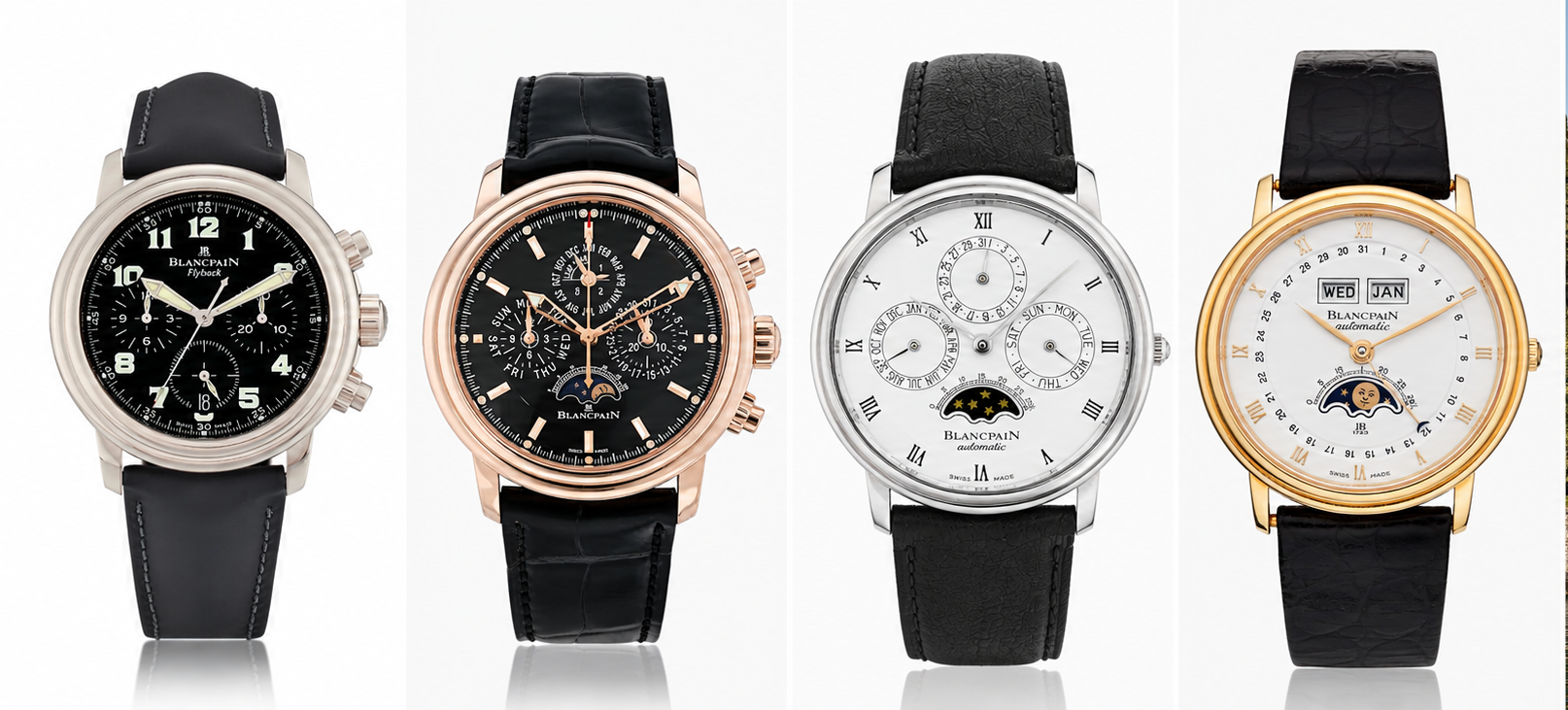
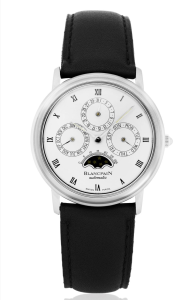
The most underrated Blancpains of this period live in two collections. The Villeret line, named for the brand’s birthplace, carried the classic look of the revival: round double-stepped cases, white or silver dials, Roman numerals and blued hands, built around complete calendars, moon phases and perpetual calendars.
The Léman line, named for Lake Geneva, took the same movements into a slightly sportier, more contemporary case. It produced some of the most interesting chronographs of the decade, including flybacks and split-seconds models, without ever becoming a sports watch in the modern sense.
Neither line fits the dive watch story the brand tells today, which is exactly why they remain overlooked. Prices for many of these references have barely moved, while neo-vintage Patek Philippe and Audemars Piguet have taken off.
The 2185F
The 2185F shows what made this era special. The steel case is around 38mm, with a stepped profile that catches light from every angle and wears like a dress watch with some muscle.
At first glance the black dial reads as one plain surface. Look closer and it separates into three concentric rings. A thin outer ring carries the minute track, with fine markers and numerals from 0 to 60. A slightly wider middle ring holds the hour numerals. The widest, innermost ring meets the three subdials. What looks simple from across the room turns out to be quietly intricate up close, and that hidden depth is what drew me to this watch.
The F stands for flyback. Press the reset pusher while the chronograph is running, and the hand snaps back to zero and starts timing again in one motion, with no need to stop, reset and restart. The function was developed for pilots timing successive legs of a flight. On the wrist, it is simply one of the most satisfying complications to use.
The Movement Behind the Royal Oak and the Overseas
Inside is Blancpain’s caliber 1185F, built on the Frédéric Piguet 1185. When it appeared in 1987, the 1185 was one of the thinnest automatic chronographs ever made, at about 5.5mm. It also combined a column wheel with a vertical clutch, two features usually reserved for the most expensive chronographs.
Other top houses took notice. Audemars Piguet used the 1185 as the base for its caliber 2385 in the early Royal Oak chronographs, and Vacheron Constantin used it for the caliber 1137 in the early Overseas chronographs. The same architecture inside a 2185F powers watches that now trade for several times its price.
Why Now
The Fifty Fathoms will keep its place at the center of Blancpain’s story, and it should. But the watches that defined the brand’s revival were dress watches and complications, made by a small team that believed in mechanical watchmaking when almost nobody else did.
Watches like the 2185F carry that story. They pair a movement good enough for Audemars Piguet and Vacheron Constantin with a design that feels more relevant every year as cases return to classic sizes. For collectors willing to look past the dive watches, this is one of the best values in neo-vintage watchmaking today. I don’t expect it to stay that way.