

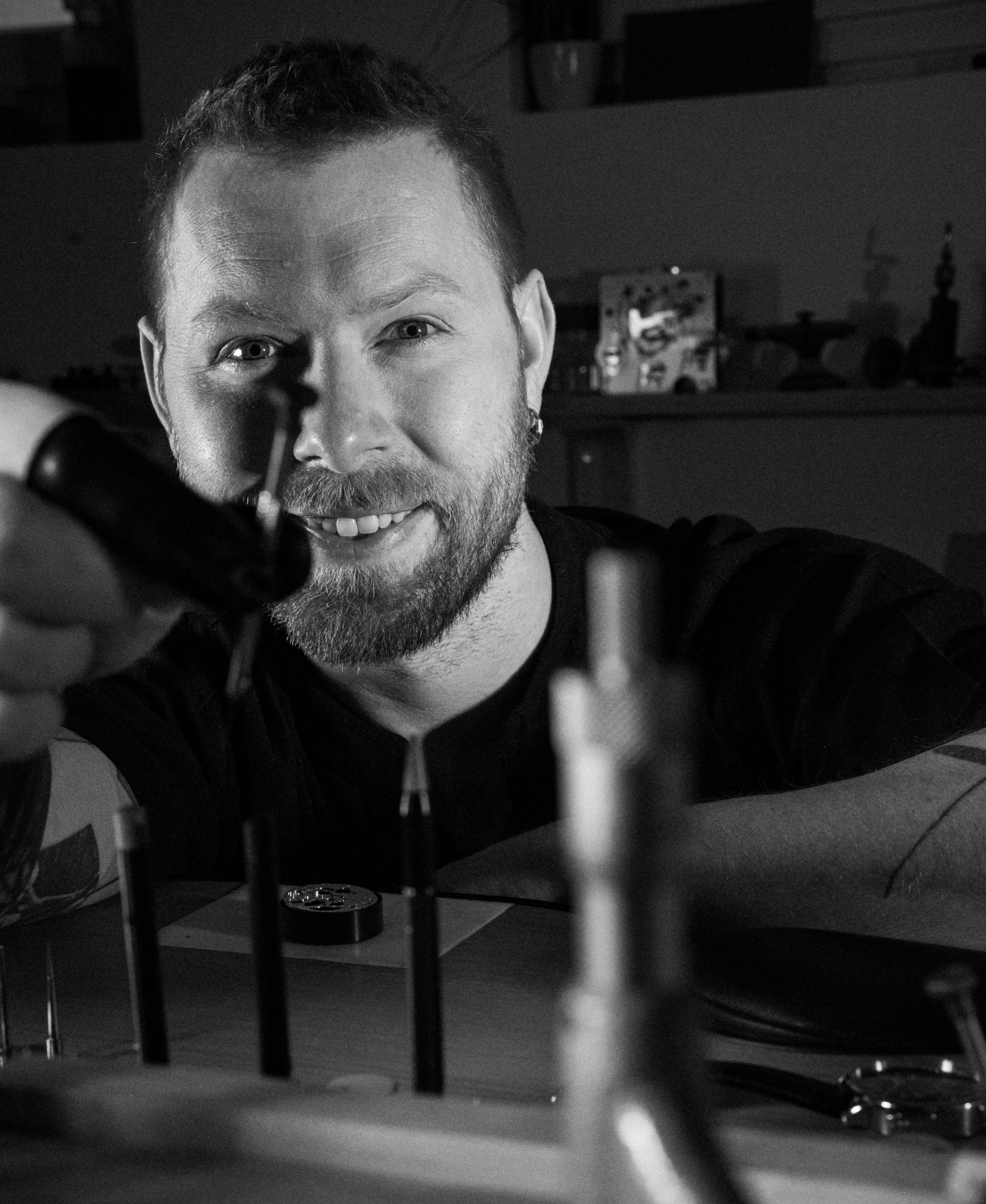
There is a particular kind of collector who changes the way you see everything after him. For me, that person is Daniel, my friend from Brazil and one of the most interesting collectors I have ever met. Daniel does not just own great watches. He understands them, the people behind them, the stories inside them, and the quiet ecosystem of independent watchmaking that most of the industry never talks about. He has introduced me to makers I did not even know existed, and more than once he has completely rearranged the way I think about what a watch actually is. I trust his eye completely, and if there is anyone leading me by the hand into this world, it is him.
It was Daniel who first mentioned Martin Honermann and HerzWerk Watchmaking. Not long after, Martin and I ended up on a Zoom call that ran far longer than either of us expected. We talked about watchmaking school, about Patek Philippe, about the strange math of running a one-man atelier. That conversation is the foundation for everything below, and I am genuinely looking forward to commissioning a piece from Martin, hopefully sometime next year.
This is also very much why I built WatchVote. Independent watchmakers like Martin rarely get the spotlight they deserve. The big maisons, and even larger independent watchmakers, have marketing departments, ad budgets, decades of brand equity. A watchmaker working alone at a bench in his own workshop has none of that. He has only the watch, and whatever story he manages to tell about it. WatchVote exists to help collectors discover, champion and give a real voice to makers exactly like Martin: people who are not chasing scale, just trying to build something honest and truly amazing.
A Magazine, By Accident
Martin’s path into watchmaking started with something almost comically small. As a kid, his family rewarded good grades with money. His sister collected hers reliably. Martin’s grades were, in his words, “rather average,” so instead of cash his mother handed him a stack of career brochures: boatbuilding, landscaping, classic cars, and watchmaking among them.
One article stuck. It featured a young watchmaking student describing her training, and something in it lodged in Martin’s mind permanently: a high-quality mechanical watch is never disposable. It will still need to be serviced and preserved decades from now. “That gave me the feeling that this was not only an interesting profession, but one with a real future,” he told me.
He enrolled at Germany’s oldest watchmaking school in 2008 and quickly discovered something that changed everything: he was good at it. “The better I became, the more my ambition, enjoyment and curiosity grew,” he said. A magazine picked almost at random became a career, and eventually, a life.
Learning From the Masters, Then Unlearning Some of It
Before there was HerzWerk, there was Zurich, and a formative stretch working alongside watchmaker Paul Gerber. Martin describes Gerber not just as technically gifted but as versatile, creative and charismatic, someone who taught a small team not merely how to execute operations, but how a watch is actually born: idea, construction, and the slow accumulation of components into a finished object. The projects ranged wildly, from work for Fabergé to complications and commissions for royal families.
“I learned to see watchmaking not only as repair or assembly, but as development, construction, design and a genuinely creative process,” Martin said. It also taught him something less technical and more philosophical: “If you want to create something special, you have to be comfortable with a certain amount of uncertainty.”
From there, Martin spent years at Patek Philippe in Munich, immersed in what he calls “absolute top-level quality built through structure, repetition and discipline.” Every fault analysis had to be precise, every repair returned to a standard worthy of the name on the dial. It sharpened him. But it also revealed a gap.
But “Something essential was missing for me: my own creative expression,” he said. “I did not only want to service and repair existing watches perfectly. I wanted to develop my own ideas, find my own solutions and recognize my own handwriting in a watch.” He also became increasingly conscious of the role that brand, heritage and marketing in general play in the luxury industry. That is naturally part of the world he came from, but for Martin, HerzWerk needed something more: he wanted as much of a watch’s value as possible to be felt directly in the object itself, in the construction, the craftsmanship, the finishing and the time invested in it.
Two Full Time Jobs, One Impossible Schedule
For a long stretch, Martin was effectively working two careers at once. Patek Philippe by day, HerzWerk by night, sometimes sitting down at the microscope around eight in the evening and working until two or three in the morning, only to be up again at six.
The decision to leave came down to a single conversation with a client, someone with real business experience, who asked him plainly what he actually wanted HerzWerk to become. Martin’s answer to himself was simple: “If I tried and it did not work; I would still be a watchmaker. I had a profession I could always return to. But if I never tried, I would never know what HerzWerk might have become.” At some point, he said, the risk of not trying started to feel bigger than the risk of taking the leap.
The Meaning Behind the Name
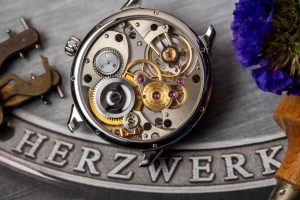
HerzWerk was not a branding exercise. It existed before the business did, attached to Martin’s earliest personal pieces while he was still in school. The name splits cleanly into two German words: Herz, heart, and Werk, work, or movement, deliberately ambiguous between craftsmanship and the mechanism itself.
“For me, HerzWerk means that a watch should not merely be technically correct,” Martin explained. “It should show that someone truly stood behind it, investing time, attention and patience, and sometimes also that extra amount of work that may not be technically necessary, but makes the difference.”
The First Complication
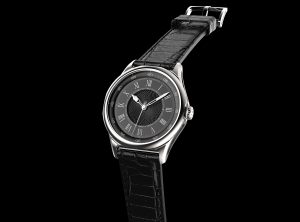
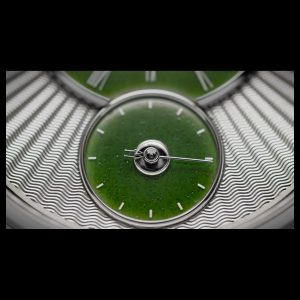
Martin’s first major complication under the HerzWerk name was, perhaps surprisingly, something relatively modest on paper: a jumping second. He had already worked on far more complex mechanisms elsewhere, perpetual calendars, tourbillons, bird automata, striking mechanisms. But building one entirely on his own, under his own name, was a different kind of challenge. The mechanism had to sit on the dial side, where there is normally almost no spare space at all, on a highly individual watch with a green porcelain dial and a platinum case.
“I had to integrate a mechanism into a place where none had originally been intended,” he said. “And suddenly, you are responsible for everything: construction, manufacturing, function and reliability.” It marked a shift he still points to today, the moment he stopped being only the watchmaker who understood and built a mechanism and became the person who had to decide what that mechanism should be in the first place.
Classic Roots, Modern Vision
Ask Martin where tradition ends and innovation begins, and he pushes back gently on the premise. Innovation, to him, does not require reinventing the wheel. “The wheel has been round for quite some time and works remarkably well,” he said. Innovation can mean reinterpreting a familiar mechanism, using space more cleverly, or connecting art and mechanics in a new way.
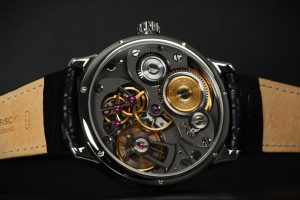
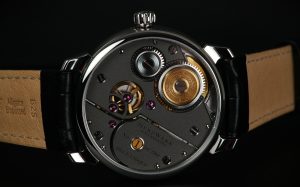
The phrase itself, “Classic Roots, Modern Vision,” was born during the development of the Artisan, his 39-millimeter flagship. From a distance the case reads as classical and round. Look closer and its underlying architecture is angular, almost square, with side surfaces carefully sculpted to keep the watch slim and balanced. Even the typography, both the Roman and Arabic numeral sets, was custom drawn for the piece, proportion by proportion.
Tradition, for Martin, extends well beyond design. He considers watchmaking an art craft, not simply a precision one. “A precision mechanic can make a component just as accurately as a watchmaker,” he said. “The difference, in my view, is that we also give that component an aesthetic dimension.” A surface is never just brought to size, it is ground, polished, beveled or decorated, and a movement, in his view, can be regarded as a work of art rather than a purely technical mechanism. That philosophy is part of why he still works extensively with conventional, non-CNC machines, many of them small, highly specialized tools that are themselves artifacts of watchmaking history.
But there is one thing Martin refuses to modernize, and it has nothing to do with aesthetics. “Every HerzWerk watch should truly come from my own hands,” he said. “I do not want to become merely the name on the dial while other people build the actual watch.”
The Finish No One Will Ever See
Perhaps the most telling answer Martin gave me was about invisible work, the kind of hand finishing tucked so deep inside a movement that a client would need a loupe or microscope to ever notice it. Why bother?
“First and foremost, it is a standard I set for myself,” he said. “A surface should not only be dimensionally correct. It should be correct and beautiful.” He describes a quiet satisfaction, not vanity, in knowing every detail got the attention it deserved, whether or not anyone ever sees it. Sometimes a client eventually does, sending him a macro photo of a detail they stumbled onto years later, and those moments, he said, remind him that a watch can be more than a collection of functioning parts.
Three Names, One Philosophy
The Artisan, the Regulateur and the Onyx are often described as HerzWerk’s collections, but Martin resists that framing. He sees them more as concepts than fixed product lines. The Regulateur borrows its layout from historical precision clocks and observatory instruments, hours and minutes together on the main dial with small seconds set apart. The Onyx pushes that same idea further with sapphire dials and far more elaborate movement decoration, which is exactly why Martin capped it at five pieces. Partly a design decision, partly a practical one: he wanted to gauge real demand while being honest about what one person could build.
“Almost every HerzWerk watch ultimately becomes a unique piece,” he told me, “not only because I build it myself, but because it evolves in close collaboration with the individual client.”
Giving Old Calibers New Life
Together with his business partner Boris Pjanic, Martin has been building unique pieces around historical movements like the Valjoux 88 and Lemania 2310, calibers from an era of exceptionally solid mechanical engineering that are only growing rarer. “What fascinates me most is the connection between past and present,” he said. It is not simply dropping a vintage movement into a new case. It means measuring it, understanding its quirks and weaknesses in detail, and designing everything around it so the finished watch feels like the past and present arrived at naturally, together.
What a Commission with Martin Actually Looks Like
Most clients arrive already drawn to Martin’s handwriting, often through an existing piece like the Regulateur, wanting a different color, a bespoke hand design, an engraving, sometimes an added complication. From there, the real conversation starts.
“What matters to me is that I can stand behind the result,” Martin said. “I only propose options that I can genuinely support.” He has turned down commissions when he felt he would not be able to identify with the final piece. But he is equally clear that client input often pushes him somewhere he would never have arrived alone. A good unique piece, he said, “is not a product where one person simply orders and the other executes. It is much more a shared development process.”
This is exactly the conversation I am hoping to have with him myself in the coming year.
Why Independents Are Having a Moment
I asked Martin why he thinks collectors are increasingly drawn to small ateliers over big maisons, and his answer landed close to why I started WatchVote in the first place.
“Information is available far more quickly than it used to be,” he said. “Collectors can study production processes in detail, compare approaches and understand much better how a watch is actually made.” That transparency exposes how much of a luxury watch’s price is craftsmanship versus brand and marketing. With an independent, that line is direct: the client can see exactly who developed, built and stands behind the piece.
There was one line from Martin that stopped me. “We live in a time in which texts, images and even elements of design can increasingly be generated digitally or with artificial intelligence. Something visibly created by a human being, with their own hands, therefore gains a different kind of significance.” In an era saturated with synthetic everything, a watch someone actually built with their hands is becoming its own kind of rare.
The Job No One Sees
Running HerzWerk alone means Martin is, in his words, “the watchmaker, developer, constructor, project manager, client contact, purchasing department, quality control, marketing, logistics, and occasionally the cleaner and the company canteen as well.” Some mornings it is ten or eleven before he actually sits down at the bench.
There is an emotional cost too, one he was candid about. “With a small independent brand, there is hardly any distance between the person behind the product and the way the watch is perceived,” he said. Feedback lands personally, and part of the job is learning to take criticism seriously without letting every opinion become the measure of his own work.
Production currently sits around eight to ten watches a year, a pace Martin protects deliberately. There is a waiting list, but he refuses to book himself out for years in advance. “In five years, I will not only be a different person, but hopefully a more developed watchmaker,” he said. Growth, to him, does not mean more watches. It means better ones.
Ten Years from Now
Martin’s vision for HerzWerk a decade out has nothing to do with production numbers. “My goal would be for someone to recognize one of my watches without first having to read the name on the dial,” he said, describing a future where HerzWerk is understood internationally as an author atelier: small, personal, every watch still built by his own hands, distinguished by its own mechanical language and a particular strength in unique commissions.
That identity, he is quick to add, is not only aesthetic. Martin wants to keep developing more of his own mechanisms, complications and constructional solutions, ideas that are technically interesting but also serve HerzWerk’s design language directly. He points to the Spherical Power Reserve as an early example of that direction, a project that is not about adding complexity for its own sake, but about bringing mechanics, aesthetics and identity together in something genuinely his own.
He is also careful to push back on the idea that serious independent watchmaking must mean six figure prices. “A watch does not need to cost 300,000 or 500,000 euros to be extraordinary,” he told me. “I want to create craftsmanship, individuality and high watchmaking with real depth, while keeping the value understandable and meaningful.”
The Life Outside the Bench
Martin’s days are split cleanly: mornings for administration and correspondence, afternoons for the actual craft, assembly, finishing, decoration, the part of the day he described as entering “a very focused and intuitive state.” Outside the workshop, sport is his counterbalance to hours of sedentary, concentrated work, alongside a genuine curiosity about physics and mechanical innovation that feeds directly back into his watchmaking. “Creativity does not necessarily mean suddenly having one great idea,” he said. “More often, it grows from remaining open, looking more closely and being willing to see something familiar in a different way.”
Why This Matters
I keep coming back to one image Martin gave me: a collector, fifty years from now, putting on a HerzWerk and simply smiling. Not because of a brand name, not because of resale value, but because of what the watch quietly carries, a story of hours at a bench, decisions made together, a mechanism someone chose to make beautiful even where no one would ever look.
That is the entire premise behind WatchVote. Independent watchmakers like Martin are building some of the most honest, personal objects in the entire industry, often with none of the visibility they deserve. If Daniel changed how I see this world of independents, and Martin’s watches changed how I understand what craftsmanship means to the watchmaker, then the least I can do is help build the platform that gets more collectors to notice.
I will be back with an update once my own HerzWerk commission is underway.