

Hervé Schlüchter: Most Important Independent You Haven’t Heard Of Yet
By Eduardo Krajewski, MD, FACS, FASCRS, MSIRE
@twofortime @watchvote.official
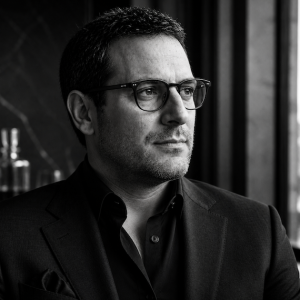
There are craftsmen who make objects. And then there are those rare individuals for whom making is inseparable from being, people whose work is not something they do, but something they are. Hervé Schlüchter belongs entirely to the latter category. He is not a watchmaker who happens to have a philosophy. He is a philosopher who expresses himself through the most precise and demanding medium imaginable.
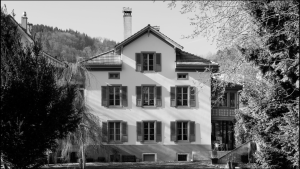
I have been fortunate enough to visit Hervé twice over the past year at his atelier in Biel/Bienne, Switzerland, specifically at a beautiful Villa, a 19th-century house tucked into the Boujean district, where the city’s fiercely independent character feels most concentrated. The first time, I brought my wife and eldest son. The second, just about a week ago, I returned with a close friend who is a serious collector. Both visits left us with exactly the same feeling: that we had encountered something and someone wholly extraordinary.
What strikes you before a single word about watches has been exchanged is the man himself. Hervé Schlüchter is warm, genuinely humble, and possessed of a passion that fills a room without demanding attention. We loved him, not merely as a craftsman, but as a human being. His philosophy about time, about the purpose of making things that endure, about the duties we owe to those who come after us, all of it resonated deeply. His devotion to his family is not a backstory to his watchmaking; it is the animating force behind it. And spending time with him, you feel that truth not as a marketing narrative but as something lived and earned.
Ice, Jura, and the Ticking of a First Movement
Hervé Schlüchter grew up in Le Bémont, a quiet village nestled in the Swiss Jura mountains, the kind of place where community is not a concept but a daily practice. His childhood was shaped by two great loves: the ice rink, where he played hockey with a ferocity and dedication that would bring him to the very threshold of a professional career, and the watchmaker’s bench, where he discovered, early and with absolute certainty, what he was meant to do with his hands.
The hockey was serious. Hervé went on to compete at a professional level for the local club, a chapter of his life that instilled in him the discipline, the capacity for teamwork, and the composure under pressure that would later define how he led a manufacturing facility and eventually his own atelier. Even today, he still laces up his skates from time to time, though he does so with a particular awareness that his hands are no longer entirely his own. They belong, in a sense, to the watches. To thousandths of a millimeter. To the hand-polished edges and the balanced wheels. A rink injury that might compromise his ability to perform that work is not something Hervé takes lightly, and it says everything about his commitment that even a sport he loves must be held at a careful distance from his craft.
He enrolled at L’École des Métiers Techniques in Porrentruy and emerged with both a diploma and an unshakeable sense of direction.
A Career Built in the Engine Room of Swiss Horology
What followed was two and a half decades at the very center of haute horlogerie. Hervé joined Montres Valgine in 1998, arriving just as the company was repositioning itself for ambitious high-end complications work. He later moved to Swiss Time Technology, working on large-scale tourbillon development, before the company was acquired and relaunched as Dimier 1738, Bovet’s movement manufacturing arm. By his early thirties, Hervé was leading the facility, overseeing patents, managing technical development, and leaving his fingerprints on every significant complication Bovet brought to market between 2006 and 2016. Double-sided watches, an expanded range of tourbillons, unique pieces of rare ambition: his influence ran quietly but deeply through all of it.
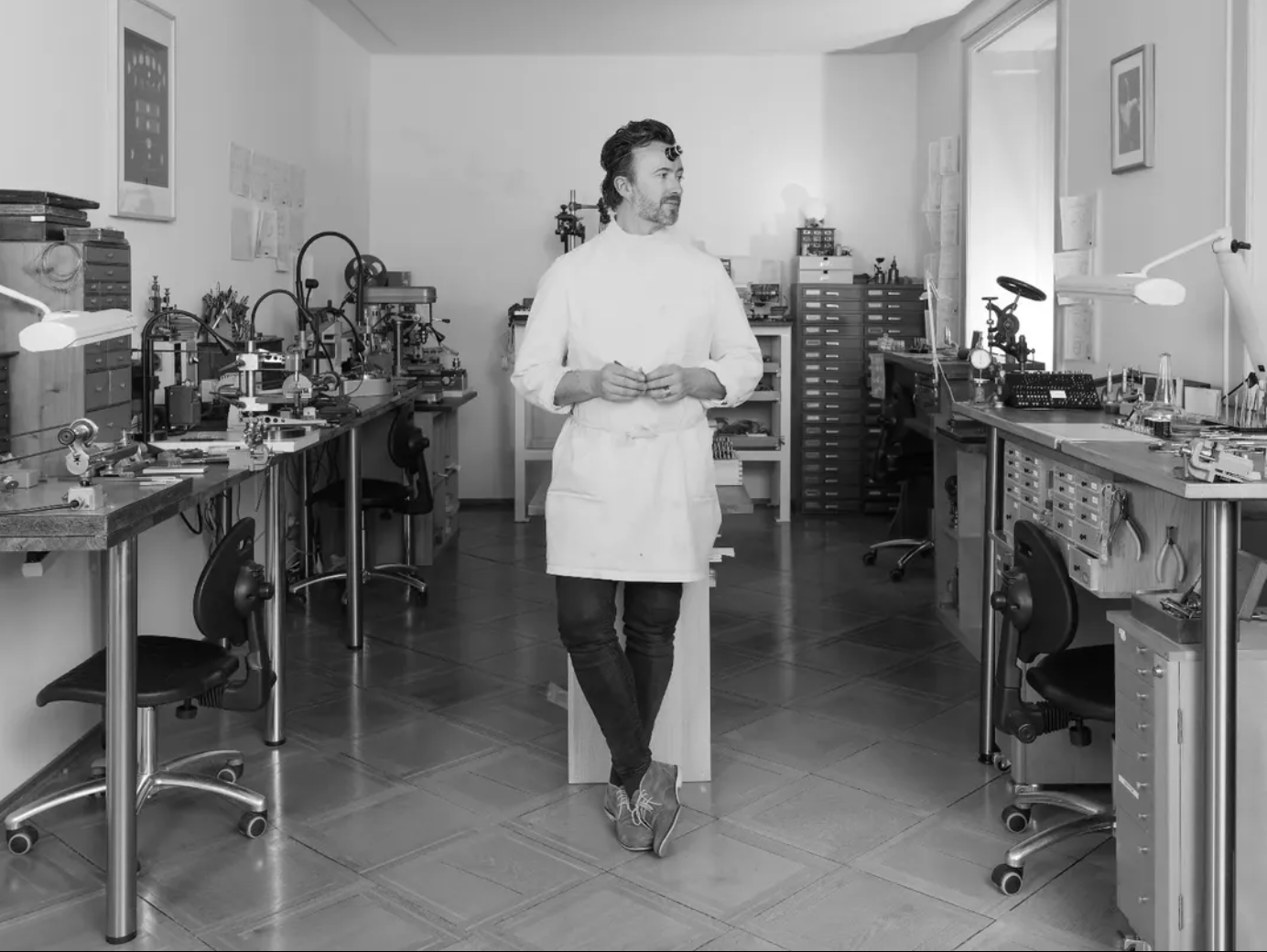
Walking through his atelier today, that chapter of his career is literally on display. The walls of the Villa are covered, generously and almost defiantly, with hand-drawn sketches of watch designs at various stages of development, alongside the patents that Hervé filed during his years as Bovet’s chief technical mind. Standing before them is a striking experience: a visual autobiography of a career spent thinking hard and creatively about mechanical ingenuity. The sketches speak to the dreamer; the patents speak to the engineer. Together, they compose a portrait of a man who was, even then, building toward something entirely his own.
The Year Everything Changed
In 2016, two events arrived in close succession and rearranged Hervé’s understanding of what truly mattered. He lost his father unexpectedly, and weeks later, Hervé’s first child was born, a son.
That collision of grief and joy demanded a reckoning. For all that his professional life had given him, he had not yet made a watch that was truly and completely his own. He left Dimier 1738, stepped away from the security of institutional watchmaking, and went independent. In doing so, he began the most consequential chapter of a life already rich with consequence.
The Disciple
Before fully committing to his own label, Hervé sought out the one watchmaker whose example had captured his imagination since very early in his career: Philippe Dufour, from the Vallée de Joux, whose work stands as perhaps the highest expression of what a single human being can achieve alone at a bench, with traditional tools and the patience to do everything properly.
Hervé traveled repeatedly to Le Brassus, sometimes remaining for days at a stretch, absorbing Dufour’s methods with the focused deliberateness of someone who has no tolerance for approximations. What began as a professional mentorship became something warmer and more enduring, a bond that Dufour himself has described in terms usually reserved for family. The old master recognized in Schlüchter something familiar: genuine mastery paired with genuine humility, and an attention to detail that borders on the obsessive.
Hervé works through it slowly and deliberately, using it to hand-polish the edges of his movements, a living thread connecting him to his mentor, and through his mentor to the long lineage of masters before them both. When you see Hervé at his bench wearing the crisp white blouse de travail, the traditional watchmaker’s coat that has become inseparable from Dufour’s own image, it does not read as tribute. It reads as inheritance.
L’Essentiel: A Watch That Carries Its Maker’s Soul
Hervé’s debut watch under his own name, L’Essentiel, is a regulator-style timepiece in stainless steel, 39mm across, restrained in size and remarkable in depth. Its hand-guilloché dial in maillechort was engine-turned by Hervé himself on a rose engine acquired from master craftsman Georges Brodbeck, who also gave Hervé his foundational education in the art. A sweeping aventurine disc rotates across a large aperture over the course of 24 hours, standing in for the conventional hour hand, an idea drawn from an obscure Antide Janvier clock dating to the early 19th century, which Hervé has studied for over fifteen years. Latin inscriptions mark the disc: HODIE NUNC beneath the sun (“Today, Now”), and AMOR GRATIA within the moon’s orbit (“Love, Gratitude”). They are not decorative choices. They are instructions for living, encoded into a mechanical object designed to outlast its maker.
The movement, conceived dial-first in the manner attributed to Abraham-Louis Breguet, draws its character from the great pocket watch calibers of the 18th and 19th centuries, prominent wheels, wolf’s-tooth gearing, a moustache escapement, finished to a standard that bears the unmistakable influence of Dufour’s teaching. All 25 subscription pieces of L’Essentiel were claimed by collectors before a single example left the atelier. A new series of L’Essentiel is on the works for collectors that missed the initial opportunity to have one.
This watch opens what Hervé calls his “Tree of Life” trilogy: three timepieces representing a child’s understanding of time, a parent’s, and a grandparent’s, each more technically ambitious than the last, each conceived as a link in a chain meant to span generations. We were lucky enough to see a complete movement prototype of the second model of the series, dedicated to the parents, and were blown away.
A Glimpse of What Comes Next: Arts and Science
During my most recent visit, Hervé shared something he has not yet widely disclosed: a new series called Art and Science, which marks a meaningful evolution in his creative direction. Where L’Essentiel led with poetry and wore its philosophy openly on its face, Arts and Science brings Hervé’s engineering instincts into fuller expression, a series in which the mechanical and the aesthetic push each other toward new territory.
The design carries Hervé’s unmistakable DNA, the constructive honesty, the quality of hand-finishing, the sense that every decision was made deliberately and for a reason, but it carries it in a more refined and, in certain respects, more architecturally confident register.
If L’Essentiel introduced the wider world to Hervé Schlüchter, Art and Science will make that world sit up. I have little doubt that this series will bring him the kind of broader recognition he has long deserved but never particularly sought. Hervé is not the kind of man who chases the spotlight. But based on what I saw last week, the spotlight will find him regardless.
The Teacher Who Cannot Stay Quiet
Perhaps what moved me most deeply across both visits had nothing directly to do with mechanisms or finishing quality, and everything to do with the future of the craft itself.
Hervé speaks about the transmission of watchmaking knowledge with an urgency that goes well beyond professional pride. The deep skills, hand-finishing from first principles, the architecture of movements conceived on paper, guilloché, the whole culture of making something with your hands that will still be keeping time a century from now, cannot be absorbed from a manual or a screen. They must pass directly between human beings, bench to bench, from someone who truly knows to someone who genuinely wants to learn. Hervé received that transmission. He takes the obligation to pass it on with complete seriousness.
He is also, at times, remarkably candid about his frustrations with what he regards as a troubling drift in the quality of watchmaking education today. He does not speak in vague terms. Having spent a quarter-century inside the industry at every level, he has watched the gap between what young watchmakers are taught and what the craft actually demands quietly widen, and it clearly troubles him, not as personal grievance but as genuine concern for something irreplaceable.
During both of my visits, I had the pleasure of briefly encountering two of the young watchmakers working alongside him, Aleandro, Francesco and Jan, who was the first craftsman to join Hervé. Both were at their benches, moving with the deliberate unhurried focus that only comes from being properly taught. The next generation of serious watchmaking was not an abstraction or a hope. It was present, in front of me, at work.
More Than a Collection
I want to say something that goes beyond the watches.
Over the course of these two visits, I have come to regard Hervé Schlüchter not simply as a maker whose work I admire and collect, but as a friend. That is not a word I use loosely in the world of independent watchmaking, where the relationship between creator and collector can sometimes remain politely transactional. With Hervé, it has felt like none of that. It has felt like the beginning of something real, a connection grounded in shared values, in honest conversation, in the particular trust that forms between people who care about the same things for the same reasons. I am not merely looking to build a collection. I am looking to forge a lifelong friendship with a man I am now proud to call a friend.
When my collector friend held L’Essentiel during our visit last week, he was silent for a long moment. Then he said, simply: “This is the best watch I have ever seen.”
I have thought about that sentence often since. It seems precisely right, and precisely why Hervé Schlüchter, a hockey player who became a watchmaker, a corporate director who became an independent artisan, a student who became a master, is on the verge of the recognition his work has always merited.
He is writing his own story. And it is a very good one.
Les Ateliers Hervé Schlüchter are located in the Boujean district of Biel/Bienne, Switzerland. Learn more at herve-schluchter.ch.